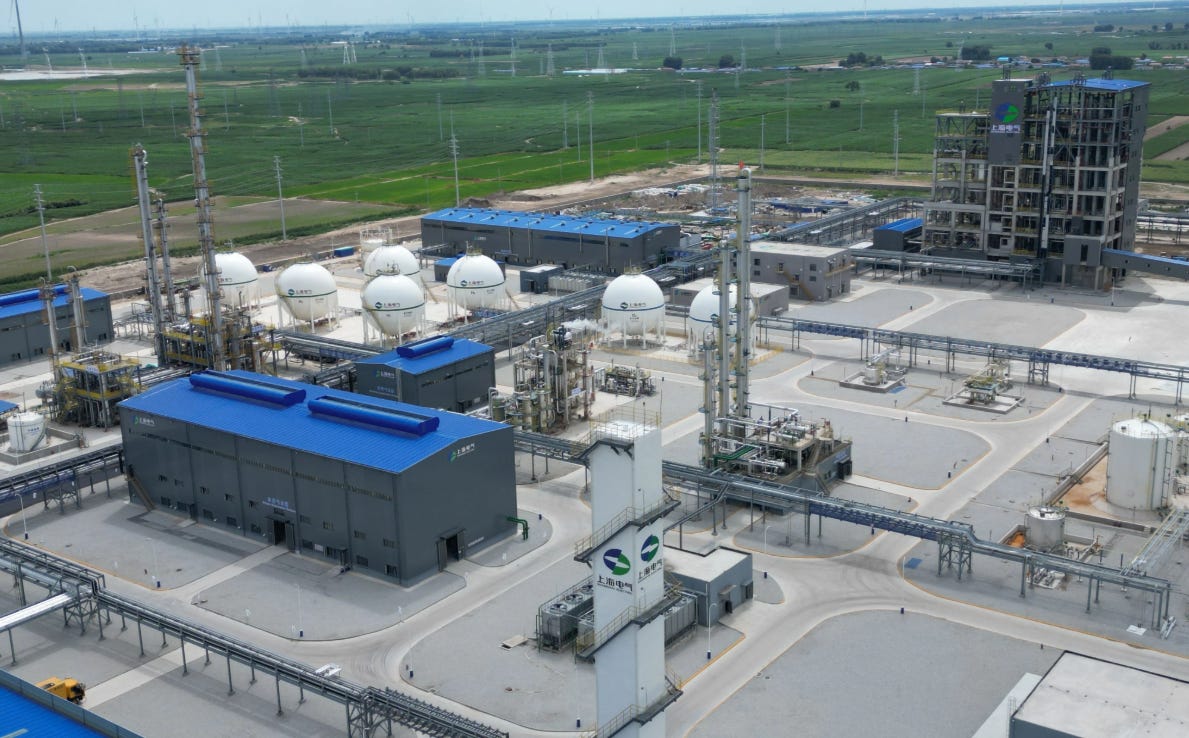
On July 15, Shanghai Electric’s Wind–Biomass Green Methanol Demonstration Project in Taonan, Jilin Province, produced its first batch of green methanol, becoming China’s first operational commercial plant to synthesize methanol solely from green hydrogen and biomass. This marks a major step toward industrial-scale decarbonization of chemicals and marine fuels by integrating wind-powered electrolysis with biomass gasification.
Located in the Songliao Clean Energy Base, Taonan benefits from about 4,000 hours of effective wind power and 1,800 hours of solar power annually, along with abundant agricultural residues such as corn stalks. Leveraging these resources, the project’s rapid execution, only 16 months from groundbreaking to commissioning, reflects a maturing supply chain and growing policy support for low-carbon fuels in China.
Full Chain Innovation
The Taonan project is based on a tightly integrated architecture of proprietary technologies developed in-house by Shanghai Electric, covering power generation, electrolysis, biomass gasification, and methanol synthesis. Phase I includes:
- 67.2 MW of on-site wind power
- 8,200 Nm³/h green hydrogen production capacity
- 10,000 Nm³ of hydrogen storage
- 2 × 300 t/d pure oxygen biomass circulating fluidized bed gasifiers
- 50,000 t/year green methanol production line
The electrolysis system combines alkaline (ALK, 8,000 Nm³/h) and PEM (200 Nm³/h) electrolyzers supplied by Shanghai Bright H Technology, a Shanghai Electric subsidiary established in 2022 with a current electrolyzer production capacity of 1.2 GW.
The biomass gasifier, designed and built by Shanghai Boiler Works (also a Shanghai Electric subsidiary), is the world’s first pure oxygen, pressurized, circulating fluidized bed system for biomass. It processes up to 300 t/day of agricultural and forestry residues with high efficiency and feedstock flexibility. All methanol synthesis equipment, including synthesis reactors and separation units, is engineered in-house and optimized for CO₂-rich syngas feedstocks.
Commercial Strategy: Certification and Partnerships
The project’s commercial model is built on three pillars: green certification, long-term offtake agreements, and public–private collaboration.
- Green Certification: ISCC EU Full Chain Approval
In December 2024, Taonan became the first project in China to achieve ISCC EU certification across the entire value chain from biomass sourcing to methanol production. Combined with ISCC EU-certified green methanol storage facilities in Yingkou (a growing regional hub for green methanol export) and green ammonia bunkering infrastructure in Dalian, this establishes a fully traceable, export-ready green methanol supply chain. - Supply Chain Lock-In: Marine Fuel Contracts Secured
In March 2025, Shanghai Electric signed multi-year offtake agreements with CMA CGM (France) and Shanghai International Port Group (SIPG) for 50,000 t/year of green methanol, securing logistics from Taonan to Shanghai via rail and sea and aligning supply with CMA CGM’s green bunkering rollout. - Government Support: Fast-Tracked Approvals
The project was designated a national “green power to hydrogen” demonstration in 2024 and included in Jilin’s “Green Hydrogen to Sea” strategy. Expedited land, environmental, and infrastructure permits enabled the project’s completion within 16 months, setting a benchmark pace for future green methanol projects.
Green Methanol for Shanghai Port: Closing the Loop
The Taonan project’s commissioning advances Shanghai’s goal of becoming a global hub for green marine fuels, alongside ports such as Rotterdam and Singapore. As part of this effort, Shanghai is accelerating infrastructure development for alternative fuels, with a particular focus on green methanol.
Meanwhile, Dalian in Liaoning Province is focusing on green ammonia. On July 25, Sinopec and China Marine Bunker (CMB) completed the world’s first green ammonia bunkering, fueling a 5,500 HP ammonia-powered vessel at COSCO’s Dalian terminal.
Both ports aim to supply international shipping lines with low-carbon fuel options. Shanghai is also advancing bunkering standards and pilot fueling projects to establish a full green methanol supply chain, strengthening its role in global low-carbon maritime logistics.
Green Methanol: Kassø vs. Taonan
The Taonan project marks another milestone in green methanol development, following Europe’s first e-methanol plant in Kassø, Denmark (May 2025). Two technology pathways—one common goal: decarbonized maritime fuels.
- Carbon Source:
- Kassø: Captured CO₂ to meet RFNBO criteria.
- Taonan: Biomass-derived syngas, eliminating the need for fossil-based CO₂ capture.
- Electricity Source:
- Kassø: Renewable electricity, primarily from wind.
- Taonan: 100% renewable electricity from a mix of wind and solar.
- Cost Structure:
- Kassø: Higher production costs driven by CO₂ capture and compliance with EU RFNBO regulations.
- Taonan: Lower cost structure due to abundant agricultural residues, no CO₂ capture, and reduced capital expenditures.
- Market Access & Pricing:
- Kassø: Targets the EU shipping market, benefiting from RFNBO premium pricing.
- Taonan: Positioned for global exports (e.g., IMO 2027) with competitive pricing and full-chain certification.
China’s Accelerating Hydrogen–Methanol Ecosystem
Taonan is China’s first hydrogen-to-methanol project, and more are on the way. Projects by Goldwind, China Energy Engineering Group, and Datang Group are expected to start commercial operations by 2026. This signals a wave of integrated hydrogen-chemicals infrastructure in China, echoing global decarbonization trends while leveraging local renewable and biomass advantages.
Building on this momentum, Shanghai Electric is expanding its climate tech portfolio. In the Taobei Economic Development Zone (~50 km from Taonan), it is constructing a 1 GWh/year vanadium flow battery plant, featuring modular, long-duration storage products tailored for wind–solar integration. Phase I is scheduled to enter trial production by October 2025.
Looking ahead, Shanghai Electric’s Taonan project is more than a technical achievement—it offers a globally relevant model for green hydrogen-based chemicals and maritime fuels. By integrating wind power, electrolysis, biomass gasification, certified production, and port bunkering, it shows that green methanol is both commercially viable and trade-ready. With strong policy support and expanding downstream infrastructure, China is well-positioned to link domestic decarbonization efforts with international clean fuel markets.