The joint laboratory connects global perovskite research with industrial-scale production, accelerating cost-efficient, high-performance solar deployment while bridging perovskite R&D breakthroughs and scalable manufacturing.
On January 14, Chinese perovskite photovoltaics leader UtmoLight officially launched the International Joint Perovskite Laboratory with the University of New South Wales (UNSW) and the Wuxi Industrial Innovation Research Institute (WIIRI). The partnership, unveiled at UtmoLight’s R&D and manufacturing center in Wuxi, marks a key step in cross-border collaboration between Australian solar research front-runners and China’s clean-energy industrial champions.
The agreement brings together one of the world’s most influential photovoltaic research institutions, a global leader in perovskite commercialization, and a municipal innovation platform designed to translate laboratory breakthroughs into scalable manufacturing solutions.
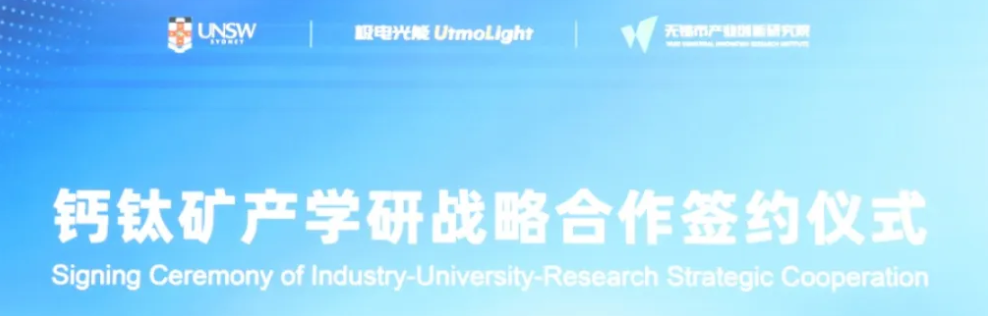
A Global Platform for Perovskite Industrialization
The joint laboratory forms the core of a broader strategic cooperation between UtmoLight, UNSW, and WIIRI. Its launch signals an advance from ad hoc academic collaboration to a structured, long-term platform focused on industrial-scale innovation and commercialization.
UNSW is widely recognized as one of the birthplaces of modern photovoltaic science, with decades of foundational research shaping today’s silicon-dominated solar industry. UtmoLight, in contrast, represents the industrial vanguard of next-generation photovoltaics, positioning itself as a global leader in the commercial production of perovskite solar technologies. The WIIRI acts as an enabling bridge, aligning research priorities with pilot-scale validation, manufacturing resources, and market deployment.
Anchoring the collaboration in Wuxi—often regarded as the birthplace of China’s photovoltaic manufacturing ecosystem—ensures that frontier research is directly integrated with one of the world’s most mature solar supply chains.
Perovskites at an Inflection Point
Perovskite solar cells are widely considered the most promising successor—and complement—to crystalline silicon photovoltaics. Lab-scale devices have achieved power conversion efficiencies exceeding 26%, approaching silicon’s theoretical limits while offering lower material usage, simpler processing, and potentially reduced manufacturing costs. Tandem silicon–perovskite architectures have surpassed 33% efficiency in research environments, well above the commercial silicon ceiling of 23–24%.
The challenge now lies in translating laboratory performance into stable, bankable, and scalable products. Key obstacles include durability, large-area uniformity, yield control, and compatibility with mass-production equipment.
The joint laboratory is designed to tackle these system-level bottlenecks. Beyond efficiency records, it focuses on materials chemistry, device architecture, process engineering, and pilot-line validation, bridging the gap between scientific discovery and manufacturable technology.

Scale, Scope & Technical Focus
The joint laboratory will operate within UtmoLight’s global innovation center, notable for its industrial-grade scale, spanning over 6,000 square meters, employing more than 100 R&D scientists and engineers.
The center, supported by an investment of CNY 30 million, is equipped with advanced characterization tools, pilot-scale fabrication equipment, and process development systems designed to bridge lab-scale experimentation and full-scale manufacturing. Research at the laboratory will focus on three core technical pillars:
- Materials system innovation: Develop perovskite compositions with improved stability, reduced lead content, and enhanced environmental tolerance.
- Device structure and process optimization: Ensure large-area coating uniformity, defect passivation, and interface engineering compatible with roll-to-roll or large-format production.
- Engineering and manufacturing integration: Align breakthroughs with pilot-line testing, yield optimization, and cost modelling.
The laboratory will also establish talent exchange and technical training programs, enabling researchers to rotate between UNSW and UtmoLight facilities, cultivating engineers fluent in both fundamental science and industrial-scale manufacturing.
From Efficiency Gains to Cost Competitiveness
Commercially, the partnership reflects growing recognition that perovskites are entering a critical commercialization phase. Global solar deployment continues to expand, yet margin pressure on conventional silicon modules is intensifying. Next-generation technologies need deliver step-change value, not incremental improvement.
Perovskites offer precisely this potential. Industry benchmarks suggest that silicon–perovskite tandem modules could increase power output per unit area by 20–30% compared with conventional silicon modules, lowering balance-of-system costs and improving land-use efficiency. Perovskite-only modules, if stability and lifetime targets are achieved, could be manufactured at lower temperatures with thinner active layers, reducing capital intensity and energy consumption.
UtmoLight’s strategy is to translate these theoretical advantages into engineering-ready products, with the joint laboratory serving as a critical enabler. By embedding UNSW’s frontier research into an industrial development pipeline and leveraging Wuxi’s innovation ecosystem, the collaboration shortens development cycles and de-risks commercial deployment.
It is also worth noting that UtmoLight’s perovskite photovoltaic module has recently received the world’s first salt mist test certification from TÜV Rheinland, marking a key step toward offshore PV applications. The certified 2.81 sqm module, produced on UtmoLight’s GW-scale production line, passed the IEC 61701:2020 Salt Mist Severity 7 test, demonstrating strong reliability and durability in harsh marine environments.

Policy & Ecosystem Alignment: Wuxi as an Innovation Hub
The Wuxi Industrial Innovation Research Institute highlights the growing role of local innovation ecosystems in China’s clean-energy strategy. Rather than separating academic research, pilot testing, and manufacturing, Wuxi actively integrates these stages into a cohesive platform.
The institute will support the laboratory through proof-of-concept validation, pilot-line services, industrial matchmaking, and funding coordination, ensuring promising technologies move swiftly from lab to production. This approach aligns with national and regional policies aimed at strengthening China’s position in advanced energy technologies while accelerating the transition from research to industrial-scale deployment.
For UNSW, the partnership provides a pathway to test scientific breakthroughs in a dynamic industrial environment. For UtmoLight, it ensures sustained access to top-tier global research capabilities, reinforcing the company’s ambition to lead in both technology development and production.
In 2024, UNSW, the Yangtze River Delta National Innovation Centre par Excellence (NICE), and WIIRI jointly established an AUD 6 million Industrial Proof-of-Concept (PoC) Fund. In June 2025, WIIRI and UNSW further strengthened their collaboration with the establishment of the UNSW (Wuxi) Technology Commercialization Centre.
Reshaping the Global Solar Value Chain
Strategically, the joint laboratory signals a broader shift in the global photovoltaic value chain. Traditionally, fundamental PV research was concentrated in select universities in Europe, Asia, and Australia, while large-scale manufacturing clustered in China. Perovskites are catalyzing a re-integration of research and manufacturing, with industrial players increasingly investing upstream into materials science and device physics.
The collaboration also reflects intensifying international competition for next-generation solar technologies. Governments worldwide are accelerating decarbonization, and technologies delivering higher efficiency and lower system costs receive policy priority and enhanced capital support. Cross-border partnerships such as UtmoLight–UNSW combine global scientific leadership with industrial scale, creating a distinct competitive advantage.