Spring Special Report I: Ancient Wisdom, Infrastructure & Integration
As water security rises on the global policy agenda, China is integrating millennia-old hydraulic design with renewable energy and AI to modernize urban systems and unlock commercial value across the water–energy nexus.
As World Water Day 2026 approaches, water management is emerging as a critical convergence point for renewable energy, AI, and urban infrastructure. In China, this shift is framed not only as a technological transition, but also as a continuation of a long-standing civilizational approach to hydrology, one that links ecological understanding with large-scale engineering.
From ancient flood control systems to AI-powered optimization platforms, China is positioning water as both a strategic resource and a data-driven asset class. One example of this continuity is Wuxi, a city whose urban form and economic trajectory have been shaped by water for more than three millennia.

From ancient feats to modern systems
China’s historical approach to water governance is often illustrated through three landmark hydraulic achievements: the Dujiangyan irrigation system (dating to 256 BCE), the Beijing–Hangzhou Grand Canal, and large-scale flood control works along the Yellow River. These projects combined engineering precision with ecological adaptation, principles that remain highly relevant in today’s climate-constrained environment.
The Grand Canal, in particular, established a north–south economic corridor integrating agricultural production, logistics, and urbanization. Cities along its route, including Wuxi, evolved into centres of trade, logistics, and hydraulic innovation.
The origins of Wuxi’s old town are closely tied to this system. The town’s historic layout, known as the “turtle-back” (龟背城) configuration, emerged during the Western Han dynasty (206 BCE–24 CE) and has remained geographically consistent for more than 2,000 years. Shaped by the branching waterways of the Grand Canal, the town developed a distinctive “one bow, nine arrows” spatial structure defined by converging and diverging river channels.
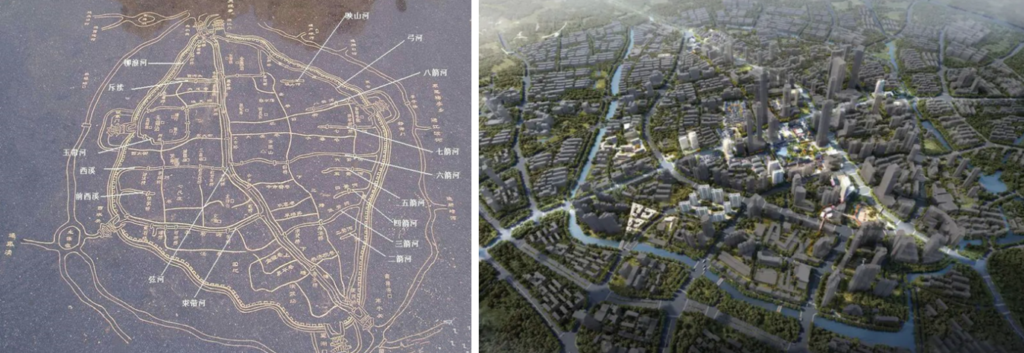
As the Grand Canal approached Wuxi from the north, it split at Jiangjianzhu into three channels. The eastern and western branches curved around the town before rejoining at Kuatang Bridge in the south, while a central canal ran longitudinally through the urban core.
This configuration created an early example of hydrology-driven urban planning, enabling flood control, inland navigation, and water distribution within a single integrated system. The pattern remains visible from an aerial perspective today, underscoring the resilience of nature-aligned design. (The images above show maps of Wuxi’s old town from the early Qing dynasty and a modern aerial view.)
Water meets AI and renewable energy
In the lead-up to World Water Day 2026, China has accelerated efforts to integrate digital technologies into water management systems. Municipalities, including Wuxi, are deploying AI-enabled platforms to monitor water quality, predict demand fluctuations, and optimize distribution networks.
These systems typically combine real-time sensor networks for hydrological and environmental data, machine learning algorithms for predictive modelling, and cloud-based platforms for dynamic resource allocation.
At the same time, renewable energy is being embedded into water infrastructure. Solar-powered pumping stations, agrivoltaic systems that transform arid land into productive farmland, and energy-efficient desalination technologies are increasingly becoming part of the water management toolkit.
Scale, cost, and demand
The commercial implications are significant. China’s water sector is expected to require hundreds of billions of dollars in investment over the next decade, driven by urbanisation, industrial demand, and climate adaptation.
Wuxi provides a microcosm of this opportunity. As an advanced manufacturing hub with strong digital infrastructure, the city is well-positioned to deploy and scale integrated water–energy systems. Key demand drivers include:
- Industrial water usage in high-tech manufacturing
- Urban population growth and rising consumption standards
- Regulatory pressure on water quality and efficiency
Industrial ecosystem development further reinforces this trajectory. The Veolia Wuxi base, its largest in the Asia-Pacific and the only facility globally with a fully integrated intelligent production line spanning specialty chemicals to water treatment equipment, illustrates this shift. Its Milli-Q ultra-pure water systems support biotech and high-end manufacturing clusters in Wuxi’s High-Tech Zone.
From a cost perspective, digital water solutions offer relatively short payback periods. AI-driven leakage detection and optimization systems can significantly reduce water loss and associated energy costs, improving operational efficiency for utilities and industrial users alike.
Reframing water as a strategic asset
The evolution of Wuxi, from a canal-based trading hub to a digitally enabled, water-centric city, illustrates a broader transformation. Water is no longer viewed solely as a natural resource or public utility; it is increasingly treated as a strategic asset intersecting with energy, data, and economic development.
As climate change intensifies global water stress, the integration of historical design principles with modern technology offers a potential blueprint for resilient infrastructure. In Wuxi, the enduring “turtle-back” urban form serves as a reminder that effective water management begins with alignment between natural systems and human design. Today, that alignment is being reinterpreted through algorithms, sensors, and renewable energy.