Lunar New Year Special IV: From Solar Hub to Space Innovator
From reusable kerosene/LOX launch systems to 34.07% efficient perovskite–silicon tandem cells, Wuxi is positioning itself at the nexus of space transport, orbital data infrastructure, and next-generation photovoltaics.
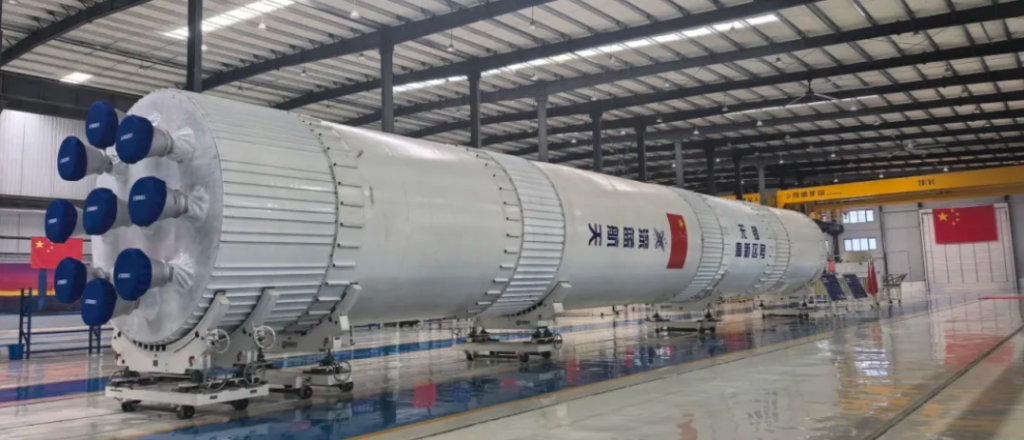
Just days after the Lunar New Year, the assembly halls of Deep Blue Aerospace headquarters in Wuxi High-Tech Zone were operating at full tempo. Engineers in white cleanroom suits moved between engine integration bays and final inspection stations as a new launch campaign gathered pace.
More than 30 engines are currently in production, and the next rocket awaits final assembly as the company prepares for what could become a defining moment in China’s commercial space race: an orbital launch combined with first-stage vertical recovery.
In parallel, a separate technological leap is unfolding in Xishan District, Wuxi. Zhongneng Solar Storage has secured international certification for a perovskite/silicon heterojunction (HJT) tandem cell with a photoelectric conversion efficiency of 34.07%, placing it among the global leaders in advanced photovoltaics and potentially reshaping the economics of space-based energy systems and orbital data centres.
Together, these developments illustrate a deeper convergence: launch costs are falling, satellite constellations are scaling, and photovoltaic innovation is redefining power-to-weight economics in orbit. Wuxi is emerging as a strategically coherent node in that transformation.
Reusable rockets: scaling China’s “flight-like” space transport
Deep Blue Aerospace’s Wuxi final assembly base, staffed by about 100 engineers and frontline workers, is ramping up production of its Nebula-1 (Xingyun-1) launch vehicle and proprietary Thunder-R series liquid oxygen–kerosene engines. The facility plans to manufacture three to five rockets and around 80 engines this year, with annual capacity rising to 10 rockets and 100 engines at full utilization, effectively operating as a commercial “rocket factory.”
The upcoming mission is ambitious: orbital insertion combined with an attempt to vertically recover the first stage. If successful, the company would become the first in China’s private sector to achieve orbit and recovery in a single mission.
Core technologies and specifications
At the heart of Nebula-1 is a nine-engine first-stage configuration using Thunder-R liquid oxygen–kerosene engines, with maximum thrust reaching 180 tonnes, equivalent to lifting more than 100 passenger vehicles simultaneously.
Each engine weighs approximately 200 kg, with roughly 85% of its structural components produced via additive manufacturing. Complex internal flow channels and irregular cavities are 3D-printed as integrated structures, reducing weight, improving precision, lowering production costs, and shortening assembly cycles.
The company has already conducted multiple low-altitude recovery tests from 1,000 m up to 5 km, progressively validating guidance, control, and landing systems. The forthcoming launch will test these capabilities under full orbital conditions.
Commercial relevance
First-stage recovery is not merely a technical milestone; it is an economic inflection point. Approximately 75% of a launch vehicle’s total cost resides in the first stage. Successful reuse would dramatically reduce per-launch expenditure and move China’s commercial launch market toward a “flight-like” operational model, akin to SpaceX’s Falcon 9.
Launch economics are decisive in downstream industries. In the US, reusable systems have reduced launch costs to roughly US$1,400–1,800 per kilogram. In China, commercial launch costs remain in the US$6,000–10,000 per kilogram range. Closing this gap would unlock new payload classes, including heavier satellite constellations and modular orbital data infrastructure.
From a value-chain perspective, Deep Blue Aerospace’s integration strategy, in-house engine development, additive manufacturing, and centralized final assembly, enhances cost control and production scalability. If annual capacity reaches 10 rockets, the facility could support regularized commercial missions, serving both satellite constellation operators and emerging space infrastructure developers.
Strategic implications
Reusable launch is increasingly a prerequisite for competitiveness in the global small- and medium-lift markets. As satellite filings accelerate, including China’s 2025 International Telecommunication Union (ITU) submissions covering more than 200,000 satellites, reliable and lower-cost launch becomes foundational.
Deep Blue Aerospace’s trajectory signals that China’s private launch sector is converging toward the SpaceX model: vertical integration, rapid iteration, and reuse-driven cost reduction. Should orbital recovery succeed, the company would materially narrow the technology gap and reshape domestic launch market dynamics.
Perovskite PVs: powering aerospace and orbital data centres
Complementing Wuxi’s rocket capabilities, breakthroughs in high-efficiency PVs are transforming the economics of orbital power. Wuxi Zhongneng Solar Storage recently achieved 34.07% efficiency in an internationally certified perovskite/HJT tandem solar cell, marking a breakthrough in high-efficiency photovoltaic engineering. The company previously set a world record in power-to-weight ratio with an ultra-thin, aerospace-grade flexible perovskite solar cell.
These advances are particularly relevant as energy provision becomes a defining constraint in space-based systems.
Space changes the equation
Space photovoltaics optimize primarily for three parameters: power-to-weight ratio, radiation tolerance, and resilience under extreme thermal cycling. Most terrestrial PV technologies maximize one or two of these metrics. By contrast, perovskites offer a broader design space.
Critically, the orbital environment mitigates two major degradation drivers for perovskites on Earth: water and oxygen exposure. In near-Earth orbit, sunlight is unattenuated by the atmosphere, with minimal seasonal variability and solar exposure exceeding 8,300 hours annually in sun-synchronous orbit (600–800 km altitude), compared with 1,500–2,000 hours for most terrestrial sites. Solar radiation intensity is more than eight times higher than on Earth and available 99% of the time, fundamentally altering system economics.
Space-based data centres: a structural break
According to Starcloud’s 2025 white paper, a 40 MW terrestrial data centre incurs more than US$100 million in electricity, cooling, water, and backup-power costs over a decade, with total expenditure approaching US$167 million.
Modelling suggests that deploying modularised data-centre infrastructure into orbit, powered by space-based solar arrays, could reduce ten-year total costs to approximately US$8.2 million. The driver is physics rather than finance. In orbit, electricity generation becomes near-continuous, while heat dissipation, a major cost on Earth, becomes largely passive through radiation into space.
As global digital infrastructure extends into near-Earth orbit, energy provision shifts from a grid-optimization problem to an orbital design problem, with photovoltaics becoming central to system architecture.
Technology transition: from GaAs to HJT and perovskites
Historically, gallium arsenide (GaAs) cells dominated space applications due to high efficiency and radiation resistance. Flexible GaAs arrays typically require 2–2.5 m² per kW, with costs around US$150 per watt, roughly half in the cell itself. As constellation scale increases, GaAs becomes a system-level bottleneck.
Falling launch costs are shifting optimization metrics from “watts per kilogram” to “watts per kilogram per dollar.” Under this framework:
- Ultra-thin HJT wafers (60–110 μm) reduce mass while enabling flexibility.
- NexWafe (Germany) has secured 250 MW in space-related HJT contracts using 70 μm wafers.
- US-based Solestial is producing 60 μm HJT cells and advancing perovskite–HJT tandems approaching 30% efficiency.
Wuxi’s 34.07% tandem cell exceeds many current benchmarks, positioning it at the frontier of efficiency-driven applications such as satellites, high-altitude platforms, and orbital data infrastructure.
At the system level, roll-out solar wings are replacing rigid Z-fold arrays, favouring thin, flexible architectures, a domain where perovskite-based technologies excel.
Cost trajectory and commercial scaling
Perovskite economics are equally compelling on Earth. Industry projections suggest:
- At GW-scale production, module costs could fall to US$110–140 per kW.
- At 10 GW scale, costs may decline further to US$70–80 per kW, below crystalline silicon benchmarks.
Unlike silicon, perovskites avoid energy-intensive ingot processes, enabling lower capital expenditure and faster iteration.
Industry consensus is converging on a “single-junction foundation, tandem breakthrough” model: scalable single-junction perovskites establish manufacturability and durability, while tandem architectures push efficiency frontiers for premium markets, including aerospace.
A systems-level convergence
The rise of reusable rockets and advanced perovskite photovoltaics is not coincidental. Lower launch costs enable larger orbital infrastructure. Higher-efficiency, lightweight photovoltaics make such infrastructure economically viable. AI-driven demand for computation, from Earth observation to autonomous systems, drives the need for distributed data processing in orbit.
Wuxi’s dual push into reusable launch vehicles and next-generation photovoltaics reflects a systems-level strategy aligned with these structural shifts.
For Deep Blue Aerospace, the near-term test is orbital recovery. For Zhongneng and other leading perovskite players in Wuxi, such as Ultolight, the challenge is scaling tandem production, validating long-term reliability, and integrating into aerospace supply chains.
If both trajectories hold, Wuxi may come to represent more than a deep-tech industrial hub. It could illustrate how terrestrial manufacturing ecosystems extend upward from rocket factories on Earth to energy systems in orbit – as humanity begins to build digital and industrial infrastructure in the orbital domain.