Strategic partnership integrates industrial data, large-scale embodied AI models, and real-world deployment to accelerate China’s push toward intelligent manufacturing and globally competitive robotics ecosystems.
Wuxi has signed a strategic agreement with embodied intelligence firm Noematrix to establish an industrial delivery capability centre, marking a significant step in the city’s ambition to lead in “AI + manufacturing”.
Announced on April 3, the center brings together Wuxi Data Group, Xishan Economic and Technological Development Zone, and one of the world’s most technically advanced embodied AI companies to build an integrated “data–model–application” ecosystem.
The project signals a broader shift in the robotics and automation sector: from hardware-centric competition toward software-defined intelligence, where high-quality industrial data and large-scale embodied models increasingly determine performance and commercial viability.
From concept to execution: closing the industrial AI loop
The newly announced centre will be located in the Yangtze Industrial Silicon Valley in northeast Wuxi, and will be designed to serve as a full-stack platform for embodied AI deployment in manufacturing. Its scope spans three core functions:
- Industrial data infrastructure development
- Embodied AI model training and optimization
- Real-world application deployment across manufacturing scenarios
At the heart of the initiative is the creation of what local officials describe as China’s first 100,000-hour high-quality industrial embodied-operation dataset, derived from real factory environments. This dataset will underpin the training of a foundational “industrial embodied brain” model, designed to enable robots to perform complex, contact-rich tasks in dynamic environments.
Unlike traditional industrial automation systems, typically limited to pre-programmed, repetitive actions, the goal is to enable robots to perceive, decide, and act autonomously under uncertainty. This reflects a transition from “demo-stage” AI to scalable, production-grade systems.
Force-centric intelligence and embodied models
Noematrix brings a differentiated technical architecture to the partnership. Its core innovation lies in a “force-centric” embodied intelligence paradigm, which tightly integrates force feedback, vision, and motion control into a unified model.
This approach addresses a longstanding limitation in robotics: while vision-based systems have advanced rapidly, most robots still lack a robust understanding of physical interaction – such as pressure, resistance, and deformation, critical for industrial tasks like assembly, welding, or material handling.
Key elements of the company’s technology stack include:
- Noematrix Brain model: A large-scale embodied AI model with leading parameter scale and performance in China, designed to encode a generalized “physical world model”
- Closed-loop data pipeline: Integrating data collection, annotation, training, and deployment
- Data acquisition system: Capturing multimodal signals (force, motion, vision) in real time
- Atomic skill library: A modular repository of reusable robotic capabilities, enabling faster task generalization
Notably, the platform leverages proprietary force-feedback datasets derived from its parent ecosystem, providing a unique training advantage in high-contact industrial environments.
This positions the system closer to what industry observers describe as a “robotic cerebellum”, capable of fine motor control and adaptive responses – rather than simply executing pre-trained trajectories.

Data as the new industrial asset
The economic logic of the project rests on treating industrial data as a strategic asset class. Wuxi Data Group, a state-owned enterprise with registered capital of CNY 20 billion, plays a central role in this model.
Its capabilities span:
- Data asset development and monetization
- Digital infrastructure (cloud, compute, and security)
- AI model development and deployment
- Financial innovation (e.g., data-backed credit products exceeding CNY 33 billion)
By combining these capabilities with Wuxi’s dense manufacturing base, the partnership aims to create a self-reinforcing industrial data flywheel:
- Data generation from real factory operations
- Model improvement through large-scale training
- Performance gains in robotic applications
- Increased adoption, generating more data
This aligns with global trends. In the US and Europe, leading robotics firms and hyperscalers are similarly investing in large embodied datasets, though most remain limited to simulation or semi-structured environments. Wuxi’s emphasis on real-world industrial data at scale could offer a competitive edge, particularly in advanced manufacturing contexts.
Solving the “last centimetre” of embodied intelligence
A key enabler of Wuxi’s embodied AI ambitions is the emergence of specialized testing and validation infrastructure, exemplified by Kailong High-Tech.
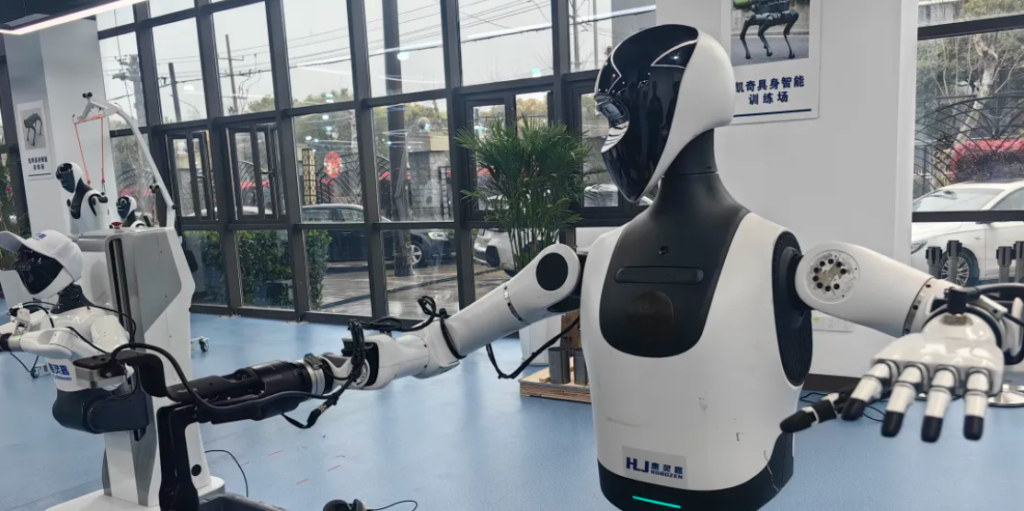
On March 30, the company launched China’s first dexterous-hand dexterity and motion-angle intelligent testing system, targeting one of the most technically challenging components in humanoid robotics: the end effector.
Dexterous hands, often described as the “last centimetre” of robotic capability, require high precision, durability, and multi-degree-of-freedom control, yet remain constrained by high costs and limited standardization.
Kailong’s system provides automated, high-precision measurement of joint motion ranges, movement speeds, and multi-axis articulation, establishing quantifiable performance benchmarks across robotic designs.
This standardization is critical for industrial adoption, reducing integration risks and enabling more scalable deployment. In parallel, the company has tested embodied robots across more than 10 industrial scenarios, including emissions inspection, heavy-load handling, welding, and precision assembly, while training over 60 robots in multi-scenario environments.
Together, these efforts position Kailong as a key enabler in bridging component innovation and system-level deployment within the embodied AI value chain.
Value chain integration: from components to full-stack solutions
The initiative in Wuxi reflects a broader attempt to restructure the embodied AI value chain. Traditionally fragmented, the sector includes:
- Hardware manufacturers (robot arms, humanoid platforms)
- Component suppliers (sensors, actuators, dexterous hands)
- Software developers (AI models, control systems)
- System integrators
The Wuxi model seeks to unify these layers through a platform-based approach, anchored by data and models, while incorporating testing and validation as a core industrial capability.
Policy and scale: a city-level industrial strategy
Taken together, these industrial and technological initiatives are reinforced by a coordinated policy framework at the city level. The partnership is closely aligned with Wuxi’s industrial policy strategy. Under its 2025–2027 development plan for embodied intelligent robotics, the city aims to:
- Exceed CNY 30 billion in industry scale within three years
- Expand to more than 200 companies in the sector
- Build a globally competitive industrial cluster
Notably, Wuxi has already invested in more than half of China’s top 10 embodied AI companies by valuation, signalling a deliberate effort to shape the national competitive landscape. The city is also deploying a combination of:
- Policy incentives
- Industrial funds (including AI and scenario innovation funds)
- Infrastructure platforms (e.g., AI innovation centres and cloud facilities)
This “policy + capital + platform” model mirrors approaches seen in leading global technology clusters, albeit with stronger state coordination.
Redefining competition in robotics
The Wuxi–Noematrix partnership signals a structural shift in the robotics sector. As hardware capabilities converge, differentiation is increasingly driven by:
- Data scale and quality
- Model architecture and training efficiency
- Integration with real-world applications
In this context, embodied AI becomes less about individual robots and more about system-level intelligence platforms.
Three strategic implications emerge:
- Data moats over hardware advantages: Access to large-scale, high-quality industrial data may become the primary barrier to entry
- Platformisation of robotics: “One brain, multiple bodies” architectures could significantly reduce marginal deployment costs
- Acceleration of AI-driven manufacturing: If successful, the model could lower automation costs in high-mix, low-volume production environments
From pilot to global benchmark
The immediate challenge will be execution. Building a 100,000-hour dataset, training a robust industrial foundation model, and achieving reliable deployment in complex factory environments remain non-trivial tasks.
If successful, the initiative could establish Wuxi as a global reference case for embodied AI in manufacturing, similar to how Silicon Valley became synonymous with software innovation.
More broadly, it reflects China’s strategic push to integrate AI with its industrial base, moving beyond digital applications into the physical economy. In that sense, the project is not just about robots – it is about redefining how intelligence is embedded into the machinery of production itself.