Capital globalization accelerates next-generation battery and photovoltaic equipment leadership
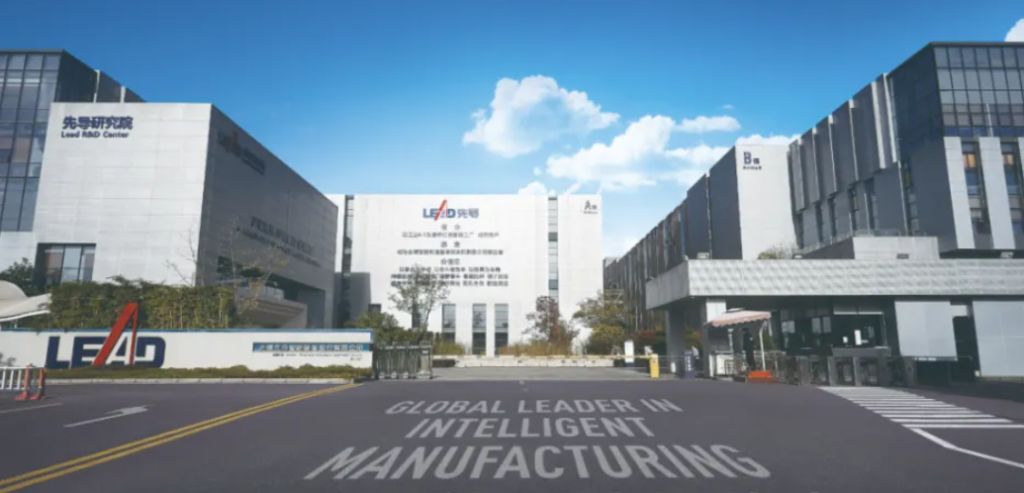
On February 11, Wuxi LEAD Intelligent Equipment successfully listed on the Hong Kong Stock Exchange (H-share code: 0470.HK), joining China’s cohort of “A+H” dual-listed manufacturers alongside its existing Shenzhen listing (A-share code: 300450.SZ). The move marks a significant milestone in the company’s international capital strategy and positions it for deeper global integration.

Founded in 2002, with entrepreneurial roots tracing back to 1999 in a small workshop near Lake Tai in Wuxi, Jiangsu, LEAD has evolved from a local equipment factory into a global provider of intelligent manufacturing solutions. Its portfolio now spans lithium batteries, photovoltaics, fuel cells, hydrogen, 3C electronics, automotive equipment, smart logistics, and fully integrated intelligent factory systems. The Hong Kong listing represents not merely a financing event, but a strategic inflection point in the company’s globalization and technology leadership journey.
Capital platform meets technology cycle
The Hong Kong debut strengthens LEAD’s ability to align capital resources with long-cycle technology development and international expansion. Structurally, the A+H model broadens access to both mainland and global investor pools, enhancing liquidity, currency flexibility, and long-term strategic financing capacity.
For a capital-intensive equipment supplier serving rapidly scaling energy transition industries, such flexibility is essential. Gigawatt-hour battery production lines require sustained investment in precision engineering, R&D, and global service infrastructure. The expanded capital platform is expected to support:
- Accelerated overseas expansion across Asia and Europe
- Continued R&D investment exceeding 10% of annual revenue
- Supply chain integration and advanced process upgrades
- Capacity expansion in solid-state batteries, hydrogen equipment, and other emerging sectors
With about 5,000 R&D professionals and more than 3,300 authorized patents, Wuxi LEAD ranks among the few global lithium battery equipment suppliers possessing fully independent intellectual property across core systems, an increasingly strategic advantage amid geopolitical complexity and supply chain realignment.
Innovation-driven manufacturing leadership
Innovation remains central to LEAD’s competitive positioning. The company consistently allocates more than 10% of revenue to R&D, building deep process expertise across the new energy equipment landscape.
In photovoltaic equipment, LEAD’s self-developed XBC stringer has surpassed 30 GW in cumulative deliveries, placing it among the leading global providers of intelligent PV manufacturing systems. Across its portfolio, products are exported to 25 countries and regions, including Germany, Japan and Korea, supported by long-term strategic partnerships with top-tier automakers and battery manufacturers.
By operating upstream, supplying core manufacturing systems rather than producing cells or modules directly, Wuxi LEAD is structurally positioned to benefit from global capacity expansion regardless of which battery chemistry or solar technology ultimately prevails.
Equipment technology frontiers
As global energy systems evolve, manufacturing capability is becoming the critical bridge between laboratory innovation and industrial scale. LEAD’s integrated solutions are accelerating the next phase of the energy transition.
I. SSB: advancing dry-electrode manufacturing
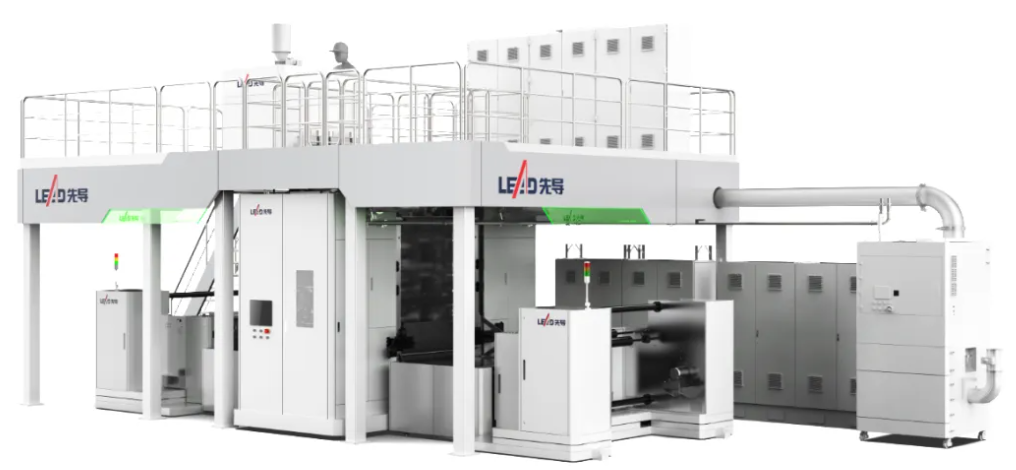
As solid-state batteries (SSB) near commercialization, manufacturing readiness is becoming as critical as materials science. Wuxi LEAD has achieved full-process integration for SSB production and introduced turnkey solutions, already delivering a range of dry-mixing and dry-coating systems to leading battery and automotive manufacturers worldwide.
At the core of this effort is the dry-electrode process, widely regarded as a pivotal breakthrough for next-generation batteries. Compared with conventional wet slurry coating, dry processing eliminates solvents, reduces drying energy consumption, and lowers both production costs and carbon emissions.
Scaling, however, remains technically demanding, particularly in stabilizing cathode film formation, controlling powder fiberization, and maintaining micron-level precision at high throughput. Wuxi LEAD’s next-generation solution successfully addresses these challenges through integrated anode–cathode process design.
The system supports graphite and silicon-carbon anodes as well as ternary (NCM) and LFP cathodes, with coating widths up to 1,000 mm and single-line capacity of 5–8 GWh. Operating at speeds of 100 m/min across a 40–400 μm thickness range, it achieves ±2 μm thickness control, ±1.5% areal density uniformity, and ±1 μm roll gap precision, while reducing energy consumption by approximately 35% compared with conventional wet coating.
At 100 m/min and gigawatt-scale capacity, the platform approaches industrial deployment rather than laboratory validation. Crucially, it remains compatible with existing liquid battery production lines, reducing technology pathway risk. Multi-line configurations can scale to tens of gigawatt-hours annually, consistent with global gigafactory benchmarks.
II. Perovskite PVs: from lab innovation to industrialization
To date, Wuxi LEAD has supported multiple customers in advancing perovskite mass-production projects, with several lines achieving module efficiencies exceeding 20% at a square-meter scale, demonstrating growing industrial viability.
Its latest perovskite turnkey production line, delivered in January 2026, centers on advanced coating processes and integrates substrate cleaning, laser scribing, coating, and vacuum deposition, covering the core steps of perovskite cell fabrication in a mass-production-ready solution. Recognizing the rapid pace of technological iteration, the line was designed with a “full-compatibility architecture”:
- Comprehensive process coverage: compatible with dry and wet routes, as well as rigid and flexible substrates
- Fully self-developed core modules: 100% independent R&D and manufacturing of key systems to ensure technological autonomy
- Integrated R&D-to-mass-production transition: flexible configuration enabling smooth scaling from laboratory validation to industrial output
Through system-level integration and process optimization, the line has reached advanced industry efficiency benchmarks. This capability supports customers’ multi-path technology exploration and positions LEAD as a key equipment enabler in next-generation solar industrialization.
III. Defining the “unmanned factory”
Beyond individual process breakthroughs, LEAD is exploring broader technological frontiers—integrating next-generation solar and battery technologies, AI-enabled intelligent manufacturing, and robotics into cohesive, data-driven factory systems.
The objective extends beyond incremental efficiency gains. It is to create fully autonomous manufacturing environments featuring intelligent scheduling, closed-loop quality control, real-time process optimization, and minimal human intervention. This convergence of advanced materials processing, precision engineering, AI algorithms, and robotics integration may form the next structural moat in high-end equipment manufacturing.
China’s equipment edge in global markets
Wuxi LEAD’s dual listing comes amid intensifying global competition. Japanese firms have traditionally led in high-precision roll-to-roll systems, while European engineering groups compete strongly in integrated process design. China’s comparative advantage increasingly lies in rapid iteration cycles, vertically integrated supply chains, and scalable deployment.
Within this landscape, LEAD’s focus on fully independent intellectual property across core systems carries strategic weight. Control over process know-how mitigates licensing and export constraints while strengthening negotiating leverage in overseas markets.
The A+H structure further enhances currency flexibility for overseas acquisitions and joint ventures, particularly relevant in Europe and other regions where battery and renewable energy incentives are increasingly tied to localized manufacturing capacity.
A signal for advanced manufacturing
LEAD’s trajectory reflects a broader transformation in Chinese manufacturing, from scale-driven expansion to technology-intensive specialization. Its sustained double-digit R&D ratio, extensive engineering workforce, and substantial patent portfolio underscore a deliberate commitment to deep process ownership and long-term technological leadership.
As the Hong Kong listing bell rang, the symbolism extended beyond a single IPO. It signaled the convergence of global capital access and next-generation manufacturing capability. With high-speed, high-precision, gigawatt-scale production capabilities and energy-efficient process design, Wuxi LEAD is positioning itself not merely as a participant in the energy transition, but as a systems architect shaping how that transition is industrialized.
For executives across the battery, hydrogen, solar, and broader cleantech value chains, the message is clear: in the next phase of global energy transformation, competitive advantage will be defined as much by factory engineering and capital strategy as by breakthroughs in chemistry or materials science.