New research platforms and national pipeline validation aim to advance hydrogen transport infrastructure, strengthen protective coating technologies, and support China’s emerging cross-regional green hydrogen economy through safer, lower-cost transmission.
China’s hydrogen economy is moving beyond demonstration projects towards large-scale infrastructure deployment, placing materials engineering and pipeline safety at the centre of industrial policy. Against this backdrop, Wuxi Zhongyou Ready Anticorrosion Technology has expanded its collaboration with leading materials scientists to commercialize advanced anti-corrosion and hydrogen protection technologies while preparing to validate coated pipelines on one of China’s first national hydrogen transmission projects.
This effort comes as policymakers accelerate long-distance hydrogen pipeline construction under the national 15th Five-Year Plan. Overcoming hydrogen-induced material degradation has become a critical prerequisite for building transport networks linking renewable-rich northern provinces with industrial demand centres along the eastern coast.
A research alliance moves from lab to field
Wuxi Zhongyou Ready Anticorrosion Technology, a specialist in corrosion protection for energy equipment with more than a decade of industry experience, has partnered with the research team led by Academician Tang Shuxian, one of China’s leading authorities in materials science and hydrogen transport.
The collaboration has established three research platforms in Wuxi:
- Hydrogen Storage and Transportation Safety and Protection Engineering Research Center;
- Hydrogen Corrosion and Protective Coatings Laboratory; and
- Joint Laboratory for Metal Corrosion and Protective Coatings.
In June, Wuxi Zhongyou and Suzhou University of Science and Technology formally signed a cooperation agreement and inaugurated the laboratories. Representatives from Wuxi’s Huishan Economic Development Zone, the Jiangsu Special Equipment Safety Supervision Institute, and CITIC Pacific Special Steel Group attended the ceremony, underscoring the project’s industrial and regulatory significance.
The partnership extends well beyond laboratory research. Under the agreement, Wuxi Zhongyou will establish an experimental station featuring coated pipelines on one of China’s first national hydrogen transmission lines, enabling coating performance to be evaluated under real operating conditions rather than solely through laboratory testing.
This progression from fundamental research to engineering validation and commercial deployment reflects an increasingly important innovation pathway for China’s hydrogen supply chain.
Hydrogen embrittlement: a critical engineering challenge
Hydrogen transport presents unique engineering challenges compared with natural gas infrastructure. Due to its small molecular size and high reactivity, hydrogen can diffuse into steel, altering its microstructure and causing embrittlement.
Protective coatings therefore serve a dual purpose: providing corrosion resistance while limiting hydrogen permeation into metal substrates, thereby extending service life and maintaining mechanical integrity under high-pressure conditions.
The newly established research centres in Wuxi will focus on coating design, performance evaluation, hydrogen embrittlement mitigation, protection technologies for repurposed natural gas pipelines, and the development of hydrogen-resistant alloys.
Research will also support the optimization of barrier coating formulations for hydrogen pipelines and spherical storage tanks, as well as field validation and standards development to accelerate commercial deployment.
National pipeline expansion creating a sizeable market
The commercial importance of these technologies is rising rapidly as China expands its hydrogen infrastructure.
Under China’s New Energy System Development Plan for the 15th Five-Year Plan period, policymakers aim to increase renewable hydrogen production to 2 million tonnes annually by 2030. The strategy includes three major inter-provincial hydrogen corridors linking Ulanqab with the Beijing-Tianjin-Hebei region, Ordos with Yulin, and Bayannur with Ningdong.
The policy framework marks a shift from isolated demonstration projects to coordinated national infrastructure planning. It combines the construction of dedicated hydrogen pipelines with the conversion of selected natural gas networks for hydrogen service or hydrogen blending.
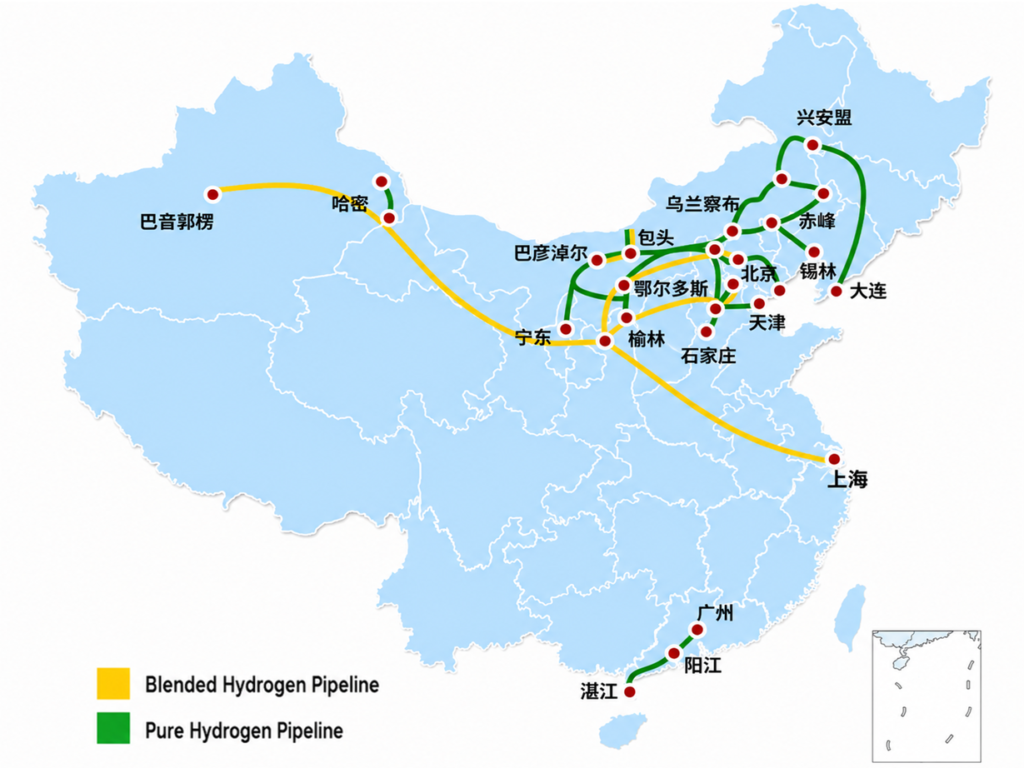
Industry data indicate that by June 2026, China’s planned hydrogen pipeline network exceeded 13,000 kilometres, comprising roughly 7,000 kilometres of dedicated hydrogen pipelines (the green lines shown in the map above) and 6,800 kilometres of hydrogen blending pipelines (the yellow lines).
However, completed projects remain relatively modest. China has commissioned 13 hydrogen pipelines with a combined length exceeding 425 kilometres, including 167 kilometres of pure-hydrogen pipelines and 261 kilometres of hydrogen blending pipelines. Together, these pipelines provide an annual transport capacity of up to 330,000 tonnes, with a maximum design pressure of 6.3 MPa.
Meanwhile, several large-scale projects, including the Ulanqab-Beijing-Tianjin-Hebei corridor, are advancing towards construction, signalling the sector’s transition from industrial demonstrations to strategic energy infrastructure.
Technology and standards advancing in parallel
Pipeline expansion has been accompanied by rapid advances in materials, equipment, and digital monitoring technologies.
China has achieved stable production of dedicated X60 hydrogen-resistant pipeline steel, while X80-grade materials have entered advanced validation as potential next-generation solutions for higher-performance transmission systems. Pipeline materials rated for 4 MPa have already been deployed across demonstration projects, while domestically developed 10 MPa materials represent the country’s highest-pressure capability currently under development.
Equipment manufacturers have also expanded domestic capability. Chinese-developed hydrogen pipeline compressors now achieve discharge capacities of 9,000 Nm³/h, supporting higher-volume, long-distance transmission. Dedicated hydrogen leak detection systems capable of continuous concentration monitoring provide an additional layer of operational safety.
Regulatory development has broadly kept pace with technological progress. New national standards governing steel plates, strip steel, and steel pipes for hydrogen service establish baseline material specifications, while industry standards covering hydrogen pipeline engineering and chemical applications provide guidance for different operating environments. Enterprise-level engineering standards further address construction, welding, commissioning, and operational management.
Together, this emerging three-tier standards framework reduces technical uncertainty and strengthens investor confidence in long-life hydrogen infrastructure.
Strategic implications beyond coatings
For Wuxi Zhongyou, the opportunity extends beyond supplying specialist coatings. The company is integrating proprietary materials, engineering services, field validation, and standards participation into a broader commercial strategy. Successful validation on national hydrogen pipelines could strengthen its position as state-owned pipeline operators and major steel producers seek qualified domestic suppliers for large-scale projects.
For the Huishan Economic Development Zone, which already hosts Tianjin University’s Wuxi Research Institute, the collaboration supports the development of an integrated innovation ecosystem connecting laboratory research, national-scale field trials, and its growth into a key knowledge centre for China’s expanding hydrogen network.
More broadly, advances in materials performance could help lower the cost of transporting green hydrogen from northern production hubs to industrial demand centres along China’s eastern coast, where pipelines are expected to become increasingly economical as network scale expands.
As China expands its hydrogen network, advances in corrosion science, protective coatings, and materials engineering will be just as important as pipeline construction itself. Technologies that extend asset life, reduce maintenance requirements, and minimize leakage will play a critical role in improving project economics and enabling the large-scale deployment of hydrogen infrastructure.