China’s first dedicated computing equipment industrial park is integrating modular AI data centers, advanced power infrastructure, liquid cooling, and high-speed interconnects into a globally competitive manufacturing ecosystem.
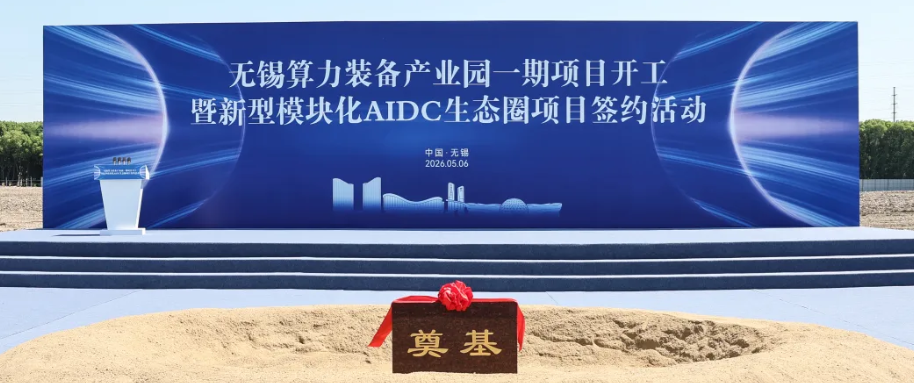
On May 6, China’s industrialization of AI infrastructure entered a new phase with the groundbreaking of the first phase of the Wuxi Computing Equipment Industrial Park. The project is designed to position the city as a global manufacturing hub for modular AI data centre systems.
The start of construction, alongside multiple ecosystem partnership agreements, comes amid an intensifying national focus on computing infrastructure. China’s 15th Five-Year Plan calls for a “multi-layered computing infrastructure system” and a nationwide integrated computing network, while recent policies identify computing network development as a strategic priority.
With over 650,000 square metres of planned industrial area and a projected annual output value of CNY 120 billion (USD 17.6 billion, about Texas Instruments’ annual revenue), the significance of the park lies not only in its scale but also in industrial ecosystem integration between Wuxi and Yixing, a county-level city under Wuxi’s administration.
Together, the two cities aim to build one of the world’s most vertically integrated AI infrastructure ecosystems, linking chips, servers, optical modules, power systems, liquid cooling, high-speed cabling, and modular data center assembly into a unified regional supply chain.
The project is China’s first computing equipment industrial park and also its first innovation demonstration base for modular AIDC systems, effectively establishing a national “core hub” for next-generation computing infrastructure manufacturing and deployment.
Modular AIDC as a core industrial strategy
At the center of the strategy is a modular artificial intelligence data center (AIDC) architecture.
Unlike traditional hyperscale data centers, which are typically built as bespoke civil engineering projects, modular AIDC systems are factory-built, prefabricated, and transportable. Computing racks, power systems, cooling infrastructure, and networking equipment are integrated into standardized modules prior to deployment.
Wuxi’s approach follows a “standardized–customized–modularized–mass production” model, transforming data centre construction from a bespoke, project-based process into a scalable manufacturing workflow. Through parallelized production, factory pre-commissioning, and standardized deployment, this model can compress traditional AIDC build cycles from years to months.
These systems are designed to incorporate advanced thermal technologies, such as liquid cooling, enabling power usage effectiveness (PUE) to fall below 1.2. More importantly, the model establishes a fully integrated and domestically controlled value chain spanning R&D, design, manufacturing, certification, logistics, installation, and delivery, closely aligned with China’s national “East Data, West Compute” strategy.
Wuxi’s industrial park aims to industrialize this end-to-end deployment model for modular computing infrastructure. Local authorities expect the first phase to become China’s first national demonstration base for modular AIDC systems upon completion in December 2026.
The first phase is anchored by a leading modular AIDC system integrator, which will act as a “chain leader” enterprise linking dozens of ecosystem partners. Together, they aim to localize the full stack from high-precision enclosures and system integration to specialized cabling and HVAC systems, creating a closed-loop regional supply chain and positioning Wuxi as a global “core hub” for computing equipment manufacturing and delivery.
One anchor project, a modular computing equipment assembly base, plans to invest CNY 1 billion and targets annual output exceeding CNY 30 billion once full production capacity is reached.
More broadly, the initiative seeks to transform AI infrastructure from a fragmented construction activity into a scalable manufacturing industry.
Rising power density reshaping data center design
The emphasis on modularization aligns with major global infrastructure trends. AI training clusters are rapidly increasing rack-level power density from the 5–15 kW range typical of enterprise data centres toward 80–150 kW or more per rack.
Such densities require fundamentally different approaches to power delivery, cooling, and system integration. As AI systems become more power-intensive, data centers increasingly resemble advanced energy facilities. Large AI clusters require high-voltage power distribution, thermal management, low-latency networking, and real-time energy optimization. Infrastructure layers once considered secondary, including cooling systems, power electronics and optical interconnects, are now emerging as strategic technologies.
This shift is creating new opportunities for industrial regions capable of integrating both electrical engineering and computing hardware manufacturing. This is where Yixing’s role becomes materially important.

Yixing: Rising role in the global AI supply chain
Rooted in a 7,000-year ceramic tradition, Yixing is famous for its purple clay teapots (photo above). In ancient times, it developed sophisticated ceramic technology in which fine-grained, unglazed clay teapots provided excellent heat retention and subtle micro-porosity, enhancing tea-brewing conditions and flavour development over time.
Today, the city is also known for advanced materials R&D and commercialization. It is one of China’s largest power equipment manufacturing centres, accounting for more than 15% of national power cable production and over 35% of the communications feeder market. Over time, it has further expanded into computing-related hardware, including optical modules, PCBs, servers, liquid cooling systems, fibre-optic cables, and intelligent power distribution systems.
Yixing combines two industrial capabilities that are becoming increasingly central to AI infrastructure: electrical engineering and computing hardware manufacturing. This convergence supports what Chinese policymakers describe as “compute-power coordination,” the integration of energy systems and computing infrastructure into a unified industrial framework.
Under this model, Wuxi functions as the integration and global delivery centre, while Yixing provides many of the enabling infrastructure technologies that underpin the ecosystem.
Building next-generation connectivity infrastructure
Leading cable manufacturers in Yixing, such as Far East Holding Group, are already shifting from traditional grid infrastructure toward AI-oriented products, including high-speed copper data cables, hollow-core optical fiber, and high-voltage DC cables.
The technical requirements are demanding. AI clusters operating at 800G and future 1.6T optical transmission speeds require ultra-low signal loss, advanced shielding, precise impedance control, and specialized materials capable of supporting high-frequency data transmission.
At the same time, Yixing is expanding into advanced PCB manufacturing for AI servers and optical modules. Local companies are developing high-layer HDI boards and high-speed backplanes, while also working to localize upstream materials such as electronic-grade resins, specialty fiberglass cloth, and high-end copper-clad laminates.
This strategy reflects China’s broader push to strengthen domestic supply chains in critical infrastructure technologies.
Liquid cooling: a competitive edge
Liquid cooling is emerging as another major growth area. Traditional air cooling is increasingly inadequate for next-generation AI accelerators, which can consume 700 W or more per chip. As rack densities exceed 100 kW, liquid cooling becomes essential for maintaining thermal stability and energy efficiency.
Companies in Yixing are moving beyond standalone cooling components toward integrated thermal management systems, including cold plates, liquid distribution units, cooling fluids, and intelligent monitoring technologies.
This transition could prove commercially significant. Cooling infrastructure accounts for a growing share of AI data centre operating costs, while thermal efficiency increasingly determines computing density and power usage effectiveness.
The sector is also expanding into next-generation intelligent power distribution systems, including solid-state transformers and advanced “power router” architectures designed to manage AI workloads and high-density electrical flows more efficiently.
Wuxi: Expanding from high-tech hub to AI infrastructure centre
Wuxi has long ranked among China’s top high-tech and advanced manufacturing centres. Historically associated with precision manufacturing, IoT, integrated circuits, and industrial automation, the city already possesses a strong industrial foundation. The AIDC industrial park extends that foundation into AI infrastructure manufacturing.
The initiative aligns with broader trends in China’s industrial policy. The country increasingly views computing infrastructure not only as a digital service but also as a strategic industrial capability tied to energy systems, manufacturing competitiveness, and technological sovereignty.
In this context, Wuxi is positioning itself not only at the global high-tech frontier but also as a national platform for AI infrastructure manufacturing and deployment. By combining modular deployment capabilities with localized supply chains spanning power systems, thermal management, interconnects, and computing hardware, its ecosystem could become a model for scaling AI infrastructure across China—and potentially internationally.