Alpha Special Report I: 100-Ton-Scale MOFs
Backed by a CNY 1 billion, 15-year “patient capital” fund, Wuxi is aligning early-stage financing, advanced materials scale-up, and industrial policy to accelerate 100-ton-scale MOFs and next-generation cleantech value chains.
In eastern China’s high-tech hub of Wuxi, a state-backed venture initiative is beginning to reshape the trajectory of advanced materials and deep-tech commercialization. The Wuxi Future Industry Angel Fund, with a total size of CNY 1 billion (approx. $140 million) and a 15-year lifespan, has, within its first year of operation, screened more than 30 high-potential projects and completed investments in 13.
The fund is part of Jiangsu province’s first cohort of “future industry” angel funds and reflects a deliberate policy shift toward early-stage, high-risk, high-impact technologies. Its mandate of “invest early, invest small, invest in hard tech” is already translating into tangible industrial bets.
Among these is its backing of a local advanced materials startup working to industrialize metal–organic frameworks (MOFs). These materials are increasingly viewed as critical enablers for hydrogen storage, carbon capture, and next-generation energy systems. The investment signals Wuxi’s ambition to evolve from a high-tech manufacturing base into a globally relevant hub for scaling frontier technologies from laboratory research to industrial application.
A “patient capital” model takes shape
The fund was jointly established by four public-sector stakeholders, including Wuxi Capital Group, Jiangsu’s provincial strategic emerging industry fund, and local innovation platforms. Its structure, an eight-year investment period followed by a seven-year exit phase, embodies a long-horizon approach rarely seen in conventional venture capital.
This “patient capital” model is explicitly designed to accommodate the long development cycles typical of deep-tech sectors such as hydrogen energy, synthetic biology, and advanced materials. It supports pilot-scale and early validation phases while providing ecosystem connections, including supply chain integration, talent acquisition, and policy navigation.
The fund’s portfolio includes commercial space, 6G communications, synthetic biology, and new materials. Notably, it operates with a highly curated investment catalogue, ensuring that each project complements Wuxi’s existing industrial base rather than duplicating it, an approach aimed at strengthening supply chain resilience and fostering differentiated industrial clusters.
MOFs move from lab to industrial scale
Against this backdrop, advanced materials, and MOFs in particular, have emerged as a focal point where early-stage capital meets industrial scalability. The transition from laboratory discovery to commercial deployment is now becoming tangible.
I. MOFs and application landscape
Metal–organic frameworks (MOFs) are crystalline porous materials formed by coordinating metal ions with organic ligands. Their defining feature is an exceptionally high surface area, often exceeding 5,000 m²/g, combined with tunable pore structures.
These characteristics enable a wide range of applications:
- Hydrogen storage: high gravimetric and volumetric storage density
- Carbon capture (CCUS): selective adsorption of CO2 with lower energy penalties
- Gas separation: efficient purification of methane, hydrogen, and industrial gases
- Catalysis and energy storage: functional materials for next-generation systems
Compared with traditional adsorbents such as activated carbon or zeolites, MOFs offer superior tunability and performance, albeit at significantly higher cost.
II. Industrial bottleneck: from grams to tons
Despite their promise, MOFs have long been constrained by scalability challenges. Laboratory synthesis typically yields gram- to kilogram-scale output using solvothermal processes, high-purity reagents, and batch production methods.
Scaling to industrial levels requires overcoming several barriers:
- Cost reduction (precursors, solvents, energy input)
- Process reproducibility and quality control
- Transition to continuous or semi-continuous manufacturing
- Consistency for downstream industrial integration
This is where Wuxi’s investment becomes strategically significant.
The fund has backed Wuxi NES Materials Technology, a startup focused on transforming MOFs from laboratory materials into standardized industrial products. The company is currently commissioning a 100-ton-per-year MOF production line at its R&D and pilot base in Wuxi, with commercial operations expected to begin in the second half of the year.
III. Patent and materials performance
Beyond scale-up, the company is advancing core material performance. Its patent, “Modification Method for MOF-801” (CN121005371A, filed May 2024), introduces a novel acid vapour activation process.
Key technical features include:
- Acid vapour etching that modifies internal pore structures
- Partial dissociation of carboxyl groups, creating defect sites
- Localized excess charge near broken bonds, generating high-energy adsorption sites
These changes result in increased hydrogen adsorption capacity and higher adsorption enthalpy, improving storage efficiency under practical conditions.
Such defect-engineering approaches are increasingly recognized globally as a pathway to bridge the gap between theoretical and practical hydrogen storage performance.
IV. Industrial implications of a 100-ton MOF line
A hundred-ton-scale facility represents a critical inflection point for the MOF industry:
- Transitioning MOFs toward industrial commodity status
- Enabling standardization and certification of material properties
- Supporting pilot-to-commercial deployment in hydrogen and CCUS systems
Globally, most MOF production remains below this scale, with only a limited number of players (such as BASF, Svante, and NuMat) reaching comparable capacity. Wuxi’s move therefore positions China closer to the forefront of MOF industrialization.
Cost dynamics are equally significant:
- Lab-scale production: $100–$1,000/kg
- Target industrial cost: <$10–$20/kg
Achieving this cost reduction would:
- Enable large-scale deployment in hydrogen storage and carbon capture
- Compete directly with established materials such as zeolites
- Unlock new applications, including distributed carbon capture and portable hydrogen systems
Policy and ecosystem alignment
These industrial advances are reinforced by coordinated policy support at both provincial and municipal levels. The fund operates within Jiangsu’s “10+X” and Wuxi’s “5+X” future industry frameworks, targeting sectors including:
- Hydrogen energy
- New energy storage
- Advanced materials
- Carbon capture, utilization, and storage (CCUS)
- Quantum technologies and other frontier domains
Unlike traditional venture capital, Wuxi’s model emphasizes tolerance for technical uncertainty, extended investment horizons, and active post-investment enablement.
In practice, this means the fund’s value lies not only in capital provision but also in ecosystem orchestration, a decisive factor in industrial technology success.
Wuxi: a deep-tech commercialization hub
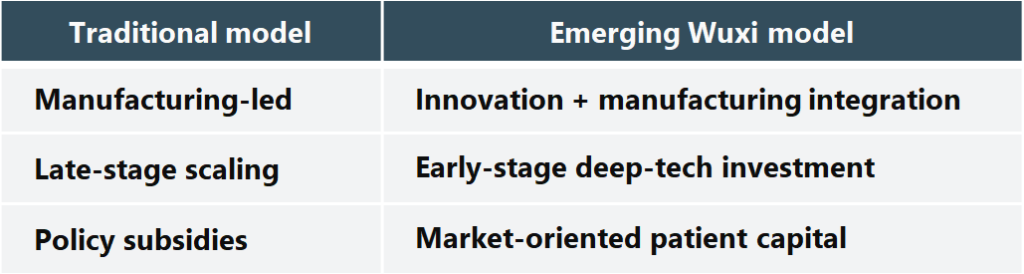
Wuxi’s approach reflects a broader evolution in China’s innovation model as it competes with global innovation clusters. In comparison:
- United States (e.g., Boston, Silicon Valley): strong in research, less integrated with large-scale manufacturing
- Europe (e.g., Germany): strong engineering base, but slower venture scaling
- China (Wuxi model): integrates research-to-factory capabilities, combining rapid scale-up, product iteration, industrial depth, and state-backed capital
Institutional backbone: scaling venture infrastructure
The fund’s diversified portfolio, from 6G to synthetic biology, reflects a structured approach to uncertainty. Central to this strategy, it is coordinated by Wuxi Capital Group, a state-owned investment platform managing more than CNY 280 billion in assets.
Its capabilities include:
- Full lifecycle investment (seed to M&A and secondary funds)
- A portfolio of over 1,600 companies
- Participation in more than 110 IPOs
This institutional depth provides continuity in follow-on financing, access to industrial partners, and multiple exit pathways. For startups, it significantly reduces the “valley of death” between early-stage innovation and commercial scale.
From seeds to systems
The Wuxi Future Industry Angel Fund illustrates a broader transformation in how advanced technologies are financed and industrialized:
- From short-term venture cycles to long-term capital alignment
- From isolated innovation to ecosystem-driven development
- From laboratory breakthroughs to industrial deployment
For MOFs, the transition to hundred-ton-scale production could represent a tipping point:
- Driving cost reductions and standardization
- Accelerating adoption in hydrogen and carbon capture
- Positioning China as a global leader in advanced adsorption materials
More broadly, Wuxi’s model underscores a critical insight for the global cleantech sector: the next phase of competition will depend not only on innovation, but on the ability to industrialize that innovation at scale – supported by capital structures designed for uncertainty and long-term value creation.