New cross-sector coalition integrates photovoltaic R&D, satellite manufacturing and testing capabilities, aiming to industrialize space-based solar technologies and strengthen China’s position in the emerging orbital energy economy.
On March 27, the Wuxi Space-Based Solar Power Industry Alliance (WSSA) was formally launched, initiated by the CREC (Wuxi) and the Yangtze Institute for Solar Technology (YIST), along with multiple research institutes, photovoltaic manufacturers, and commercial aerospace companies.
The alliance brings together more than 20 stakeholders, including:
- Six research institutions, including YIST and the Wuxi Institute of Inspection, Testing and Certification
- Ten PV developers, including GCL Group, Hongyuan Green Energy, Autowell Technology, Sinoma Jinxin, UtmoLight, and DR Technology
- Five commercial space companies, including GalaxySpace and Guoyu Xingkong
The initiative marks a coordinated push to industrialize orbital power technologies and reflects a deepening convergence between China’s fast-scaling terrestrial solar sector and its increasingly sophisticated commercial space industry.
During the launch ceremony, the alliance signed a collaboration agreement with the National Solar Photovoltaic Product Quality Inspection and Testing Center (CPVT) to jointly establish a public service platform for space PV product testing and certification.
The platform will support joint research into testing methodologies, standards development, talent cultivation, and the construction of simulated space-condition and in-orbit validation environments – critical enablers for the high-quality development of the space photovoltaic sector.
Institutional alignment around a new energy frontier
At its core, the alliance is designed to accelerate the development and commercialization of space-grade photovoltaic systems, technologies capable of operating under extreme orbital conditions while delivering reliable power for satellites, communications payloads, and future space-based infrastructure.
The newly announced testing and certification platform represents a foundational step in addressing one of the sector’s key bottlenecks: the absence of standardized verification systems comparable to those in terrestrial PV markets. Its planned capabilities include:
- Simulation of space operating conditions, including radiation exposure, thermal cycling, and vacuum environments
- Development of technical standards and certification frameworks for space PV products
- Reliability testing and lifecycle validation under mission-relevant conditions
- Establishment of specialized engineering teams and high-level talent pipelines
By institutionalizing these capabilities, Wuxi is building the enabling infrastructure required to transition space solar technologies from laboratory-scale innovation to industrial deployment.
From terrestrial PV to orbital energy systems
Space photovoltaic systems differ fundamentally from ground-based solar installations in both engineering design and performance requirements. While terrestrial systems are rated in gigawatt-peak (GWp) under standardized conditions, space systems must optimize for a distinct set of constraints:
- Power-to-weight ratio (W/kg): a primary determinant of launch cost efficiency
- Radiation resistance: requiring advanced semiconductor materials and protective coatings
- Deployable architectures: such as foldable or rollable solar arrays (“solar wings”)
- Thermal stability: to withstand temperature fluctuations exceeding ±150°C in orbit
Chinese manufacturers participating in the alliance are expected to leverage high-efficiency photovoltaic technologies, particularly multi-junction gallium arsenide (GaAs) cells and emerging perovskite-based solutions, which can achieve efficiencies above 30%, compared with approximately 22–24% for leading terrestrial silicon modules.
In parallel, developments in the “space computing as a service” (SCaaS) frontier are reinforcing the importance of reliable orbital energy systems. Earlier this month, China completed a technical demonstration of using space-based AI to control a ground robot via natural language commands, underscoring the growing integration of computing, communications, and power systems in orbit.
GalaxySpace: scaling satellite energy systems
Founded in 2018, GalaxySpace has emerged as a leading private-sector player in China’s commercial space industry, specializing in satellite internet solutions and satellite manufacturing across communications payloads, core subsystems, and integrated platforms. The company exemplifies both the system-level integration challenge and the accelerating commercial momentum of China’s space ecosystem.
On March 30, GalaxySpace completed IPO tutoring registration with the Beijing Securities Regulatory Bureau, marking a critical step toward a public listing.
Technically, the company has demonstrated key capabilities, with satellites featuring:
- Integrated solar wings for onboard power generation
- Satellite-based base stations enabling direct-to-device (D2D) communication
- Modular, low-cost satellite platforms designed for mass production
The launch of its GW constellation Group-07 satellites in August 2025, followed by Group-19 in January 2026, marked the first time a private Chinese company independently manufactured satellite batches at scale for a national broadband constellation.
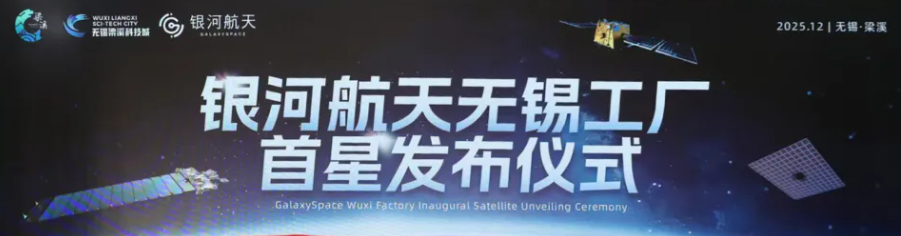
Wuxi plays a critical role in this expansion. In December 2025, GalaxySpace unveiled the first satellite produced at its Wuxi facility, which is being developed into a global satellite energy systems supply centre. The site is expected to reach annual production capacity at the thousand-satellite level, signalling a parallel scale-up in solar array manufacturing, power management systems, and integrated energy solutions.
The next phase, now reinforced by the Wuxi alliance, is the industrialization of satellite energy subsystems, including solar arrays, power electronics, and onboard storage, forming a critical bridge between photovoltaic manufacturing and space system integration.
Satellite energy scaling as a supply chain opportunity
The commercial rationale for the alliance is grounded in scale economics, localization, and vertical integration. China’s commercial space sector is entering a rapid growth phase, especially at the regional cluster level.
Wuxi currently hosts 325 aerospace and space-related companies, including 52 medium- and large-sized commercial space enterprises. The city’s commercial space industry is projected to exceed CNY 100 billion in annual output by 2029.
Satellite constellations, particularly in low Earth orbit (LEO), are a key driver. China’s “GW constellation,” comparable in ambition to SpaceX’s Starlink, is expected to require thousands of satellites, each dependent on reliable and cost-efficient energy systems.
This creates a sizeable addressable market for space photovoltaics:
- A single LEO satellite typically requires 1–10 kW of onboard power
- A 1,000-satellite constellation implies 1–10 MW of deployed orbital PV capacity
- Including redundancy, degradation, and replacement cycles, cumulative demand is materially higher
Unlike terrestrial solar assets, which operate at capacity factors of 15–25%, space-based systems can achieve near-continuous generation outside eclipse periods, significantly improving effective energy yield.
From a value chain perspective, the alliance aims to integrate:
- Upstream: high-efficiency photovoltaic materials and radiation-resistant components
- Midstream: module manufacturing and deployable structure engineering
- Downstream: satellite integration, communications payloads, and application services
This approach mirrors China’s terrestrial solar industry, where end-to-end supply chain control has driven cost reductions exceeding 80% over the past decade.
In parallel, Wuxi is strengthening its launch capabilities. Deep Blue Aerospace is advancing reusable rocket development, with more than 30 engines currently in production and a next-generation rocket nearing final assembly, targeting orbital launch with first-stage recovery.
Currently, four of China’s top private commercial space companies (LandSpace, Space Pioneer, Orienspace, and Deep Blue Aerospace) have established operations in Wuxi. In Jiangyin, a CNY 2 billion “rocket factory” is under construction, focusing on the development of the Feiyan-1 and Feiyan-2 liquid-fuel launch vehicles, designed to rank among the highest-thrust systems in China’s commercial pipeline.
Accelerating the global space energy race
The formation of the alliance reflects a broader strategic shift: positioning space-based energy as a future industrial domain rather than a purely experimental field.
Globally, space-based solar power (SBSP) is attracting renewed attention. Programs in the US, Europe, and Japan are exploring orbital solar systems capable of wirelessly transmitting energy to Earth, although most remain at the research and demonstration stage. While large-scale deployment remains long term, nearer-term applications, particularly powering satellite constellations and in-orbit infrastructure, are already commercially relevant.
Wuxi’s strategy focuses on adjacent, scalable applications, including:
- Satellite internet and direct-to-device connectivity
- Earth observation and geospatial data services
- Emerging in-orbit computing and manufacturing platforms
By combining manufacturing scale with system integration capabilities, Wuxi is positioning itself as a hub for both hardware supply and vertically integrated space infrastructure.
The city’s industrial policy further reinforces this trajectory. Under China’s “14th Five-Year Plan (2020–2025),” Wuxi has prioritised the development of a full “star–rocket–network–terminal” ecosystem, covering the entire space infrastructure value chain from R&D to application. Looking ahead, continued policy support is expected to further expand commercialization pathways and industrial clustering in the next planning cycle.
The addition of space photovoltaics completes a critical link: energy supply. Without scalable, cost-effective power systems, neither large-scale satellite constellations nor future orbital platforms can achieve sustainable economics.
From pilot to industrialization
The success of the Wuxi alliance will ultimately depend on its ability to translate coordination into tangible industrial outputs: certified products, standardized components, and commercially deployed systems.
Key milestones to watch include:
- Establishment of national and international standards for space photovoltaic systems
- Cost reduction and scalability of high-efficiency, space-grade solar cells
- Integration of energy subsystems into mass-produced satellite platforms
- Expansion of testing infrastructure to support long-duration mission validation
If successfully executed, Wuxi could replicate in space photovoltaics what China has achieved in terrestrial solar: transforming a high-cost, specialized technology into a globally competitive, industrial-scale sector.
By this, the city would not only underpin China’s commercial space ambitions but also position itself at the forefront of a nascent global market where energy and aerospace increasingly converge.