Wuxi’s new agricultural robotics hub combines sales, deployment, technical support and turnkey solutions, reflecting China’s broader push to commercialize embodied AI and smart farming technologies.
On June 5, Wuxi opened China’s first agricultural robotics 4S store, marking a significant step from technology demonstrations toward the scalable commercial deployment of farm automation.
Located in Wuxi High-Tech Zone and spanning more than 20,000 square metres, the facility was launched by the Smart Agricultural Robotics Institute of the Yangtze River Delta National Innovation Center. The site adapts the automotive industry’s proven “4S” model to agricultural robotics. However, unlike traditional vehicle dealerships, the fourth “S” stands for “solution” rather than “spare parts”, reflecting a strategic shift from selling robots to delivering complete farm productivity systems.
The launch comes as China accelerates investment in agricultural technology to strengthen food security, address rural labour shortages, and modernize agricultural production through robotics, artificial intelligence and precision farming.
From robot sales to farm solutions
The facility is designed as a full-lifecycle service platform covering demonstration, sales, deployment, maintenance and operational consulting. Its goal is not simply to market robots but to help growers and agricultural enterprises implement end-to-end automation solutions.
That distinction is commercially significant. Across global agriculture, many automation projects struggle to scale not because of hardware limitations, but because farms face challenges integrating new technologies into existing workflows. By bundling equipment, technical services and deployment support, the 4S model aims to reduce adoption barriers and accelerate commercialization.
The approach mirrors a broader trend in industrial automation, where value increasingly shifts from equipment sales toward systems integration, software and recurring service revenues.
A showcase for embodied AI in agriculture
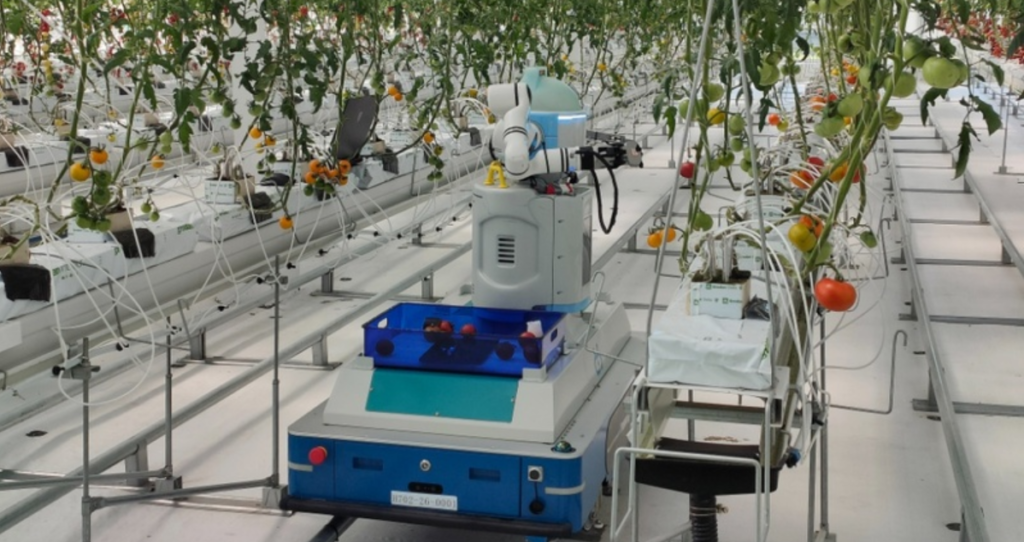
The facility’s smart greenhouse serves as a live demonstration environment for a range of autonomous agricultural systems.
Greenhouse logistics robots transport materials between cultivation zones, while inspection robots continuously collect crop-growth and plant-health data. The most advanced demonstration features an embodied AI harvesting robot designed for greenhouse tomato production.
Equipped with dual robotic arms, the system is trained using motion data captured through wearable exoskeletons. Human operators perform harvesting tasks while the exoskeleton records movement patterns, allowing the robot to learn hand-eye coordination, colour recognition and fruit maturity assessment.
The approach reflects a growing trend in embodied AI, where robots learn complex physical tasks through observation and imitation rather than relying solely on pre-programmed instructions. For agriculture, an environment characterized by biological variability, changing conditions and delicate handling requirements, such learning-based systems could significantly expand the range of economically viable automation applications.
Commercial opportunities beyond harvesting
While harvesting attracts the most attention, the facility also showcases technologies that may offer faster commercial returns.
One example is a greenhouse ultraviolet robot designed to reduce reliance on chemical pesticides. The system autonomously navigates crop rows and uses UV treatment to suppress common greenhouse diseases such as powdery mildew and grey mould.
According to project partners, the technology can improve worker safety by reducing chemical exposure while lowering pesticide use and improving crop yields. Its autonomous navigation system also enables nighttime operation, increasing equipment utilization without disrupting daytime farm activities.
The emphasis on disease management reflects a broader reality in agricultural robotics: near-term commercial opportunities are often found in repetitive, labour-intensive tasks such as monitoring, crop protection, logistics and inspection, where technical complexity is lower and utilization rates are higher than in fully autonomous harvesting.
The 4S store opening ceremony also featured the signing of strategic cooperation agreements with the National Grass Industry Technology Innovation Center and Chile-based CMPC, one of the world’s largest forestry and pulp companies. These partnerships are intended to help move agricultural robotics from pilot projects to large-scale industrial adoption.
Wuxi’s expanding agri-tech and robotics ecosystem
The agricultural robotics initiative forms part of Wuxi’s broader position as a global leading centre for advanced manufacturing, food technology and industrial innovation.
The city combines strengths in manufacturing, digital technologies, food science and automation, creating a strong foundation for next-generation agri-food innovation. Agricultural robotics sits at the intersection of these capabilities, integrating sensors, AI, machinery, biological sciences and food production into a unified innovation ecosystem.
For Wuxi, the AgRobotics 4S store is not an isolated project but another building block in a long-term strategy to develop high-value industrial clusters centred on intelligent manufacturing and future food systems.
I. China’s national IoT frontier
Wuxi has long been regarded as one of China’s pioneering cities for the Internet of Things (IoT). In 2009, it was designated by the State Council as China’s National Sensor Network Innovation Demonstration Zone, becoming the birthplace of many of the country’s earliest IoT initiatives.
Over the past decade, the city’s IoT industry has grown into a major economic pillar. More than 3,500 IoT companies now operate in Wuxi, generating annual revenue exceeding CNY 500 billion. Their applications span smart manufacturing, logistics, urban infrastructure and agriculture. This deep expertise in sensing and connectivity provides a strong foundation for intelligent farming systems that rely on real-time monitoring, environmental sensing and autonomous decision-making.
II. A growing robotics powerhouse
Building on its manufacturing base, Wuxi has emerged as one of China’s fastest-growing robotics hubs, attracting both industrial robotics companies and a new generation of embodied AI startups, including MagicLab (Magic Atom).
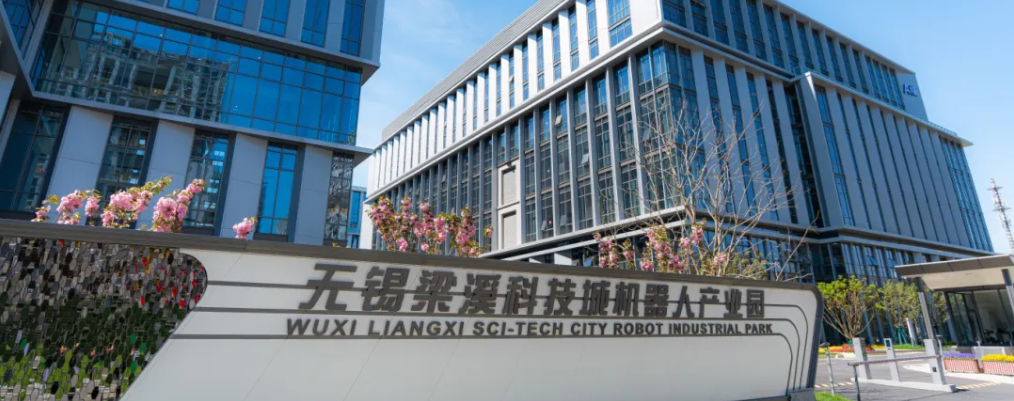
In April 2026, the city launched Jiangsu Province’s first provincial-level embodied intelligence robotics innovation centre, focused on robotic systems, dexterous hands, joint modules and electronic skin. The centre aims to accelerate the commercialization of embodied AI while strengthening a comprehensive robotics supply chain.
Investment continues to flow into the sector. In January 2026, JD.com broke ground on its intelligent robotics and advanced manufacturing base in Wuxi, integrating R&D, manufacturing, testing, and commercialization functions. With a total investment of CNY 10 billion, the project will be JD.com’s first global “super factory” dedicated to intelligent logistics robots.
In April 2026, Quicktron’s CNY 1 billion global headquarters began operations in Wuxi. The facility serves as the company’s global production headquarters, as well as R&D, manufacturing and testing centres. Quicktron is one of the world’s top four warehouse autonomous mobile robot (AMR) companies.
III. Global agri-food companies deepen their Wuxi presence
Wuxi has become an increasingly important hub for multinational companies in food processing and agricultural technology, including the Swiss-based Bühler Group.
Bühler’s grain and food processing business covers a wide range of technologies, including wheat milling equipment, corn processing systems, feed production solutions, optical sorting machinery, and edible oil extraction and refining technologies. In China, the company is widely known for its integrated “grain-to-food” processing solutions.
Globally, Bühler equipment is used to process approximately 65% of the world’s grain, and its systems handle around 2 billion tonnes of food annually, including grains, rice, pasta, chocolate, and other staple and value-added food products. This makes the company one of the most influential players in the global food manufacturing industry. According to Bühler, roughly 2 billion people consume food produced on its equipment each day.
Since entering Wuxi in 1994, Bühler has expanded its footprint to seven legal entities in the city, which now serves as the company’s regional headquarters for China and Southeast Asia. Its Wuxi operations include eight manufacturing plants, innovation laboratories, training facilities and application centres that support customers across Asia.
In May 2026, Bühler executives met with Wuxi officials to further enhance cooperation. The discussions underscored the growing convergence between agricultural production, food processing, industrial automation, and digitalization.
IV. Jiangnan University anchors the knowledge base
A key pillar of Wuxi’s innovation ecosystem is Jiangnan University, China’s top university in food science and agri-food research.
Its Agricultural Sciences discipline ranks within the top 0.01% globally according to Essential Science Indicators (ESI), placing it among the world’s most influential research programmes in the field. Its Food Science and Engineering discipline has ranked first globally for seven consecutive years in the ShanghaiRanking Global Ranking of Academic Subjects.
Jiangnan University also demonstrates strong technology commercialization capabilities. It has consistently ranked among China’s top 30 universities by technology transfer value since 2020, reflecting its ability to translate scientific research into industrial applications.
From pilot projects to a farm automation ecosystem
The Wuxi agricultural robotics 4S store is more than a new retail concept. It reflects a broader shift in agri-tech from selling standalone machines to delivering integrated automation solutions that combine hardware, software, services and operational support.
For China, the model aligns closely with national priorities around food security and agricultural modernization. For the global agri-tech industry, it offers an early blueprint for commercializing embodied AI through service-oriented business models rather than relying solely on technology deployment.
Its long-term success will depend on whether it can deliver measurable improvements in productivity, labour efficiency, and farm profitability. If successful, Wuxi’s 4S store could become a model for scaling agricultural robotics from isolated deployments into fully integrated farm automation ecosystems.