China’s industrial decarbonization drive is ushering in a new phase of strategic capital allocation by municipal investment platforms, shaping investment flows across semiconductors, batteries, AI, advanced manufacturing, biotech, hydrogen, and other strategic technologies.
China’s latest industrial decarbonization campaign is poised to reinforce the role of government guidance funds (GGFs) as a key policy tool, with Shenzhen, Wuxi and Hefei emerging as three distinct models for deploying state-backed capital into strategic sectors. Often described as a cornerstone of China’s “patient capital” strategy, GGFs have become one of the country’s most important mechanisms for directing long-term capital into key sectors for economic modernization and technological self-sufficiency.
In the past two months, China has issued a series of decarbonization policies, including AI-energy system integration (NEA No. 34), green power direct connection (NDRC No. 688), and the three-year industrial decarbonization plan (NDRC No. 698).
These policies create a significant opportunity for cities capable of mobilizing long-term capital into industrial upgrading, intelligent manufacturing, cleantech, and low-carbon technologies. Among China’s leading municipal investment ecosystems, Shenzhen, Wuxi, and Hefei represent three increasingly differentiated approaches to state-guided industrial development.
Shenzhen: China’s most market-oriented fund ecosystem
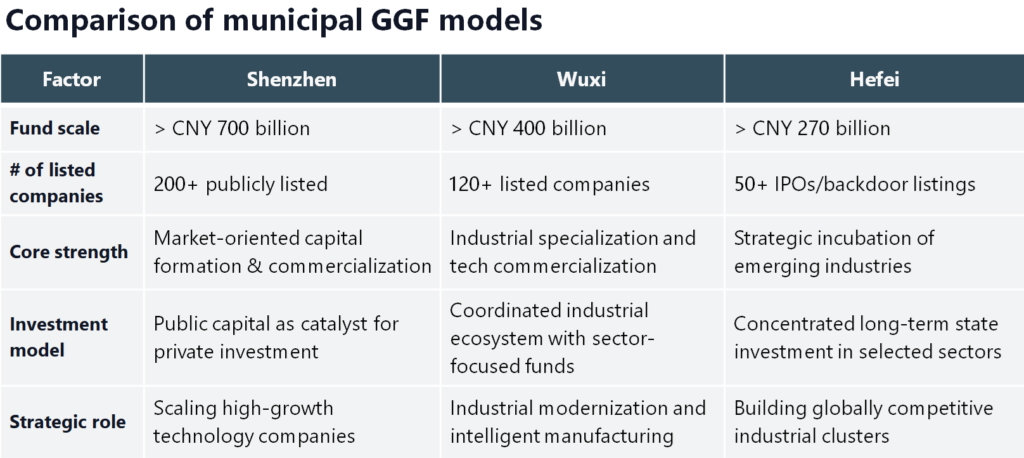
Shenzhen holds China’s largest GGF platform for early-stage technology investment and the third-largest overall GGF ecosystem, after Beijing and Shanghai. The city oversees more than 500 funds with a combined scale exceeding CNY 700 billion, supported by more than CNY 150 billion in paid-in government capital. Thirteen government guidance funds have leveraged an estimated CNY 500 billion in additional social and private-sector capital, creating one of China’s most mature public–private investment ecosystems.
At the center of the system is Shenzhen Capital Group (SCGC), which manages nearly CNY 160 billion in government guidance funds. The platform has invested in more than 1,700 companies and helped support the listing of 274 enterprises, making it one of China’s most influential institutional investors.
Unlike traditional state-led investment models, Shenzhen’s ecosystem spans the entire capital continuum, including seed funds, angel funds, venture capital, industrial funds, M&A vehicles, secondary-market (S) funds, and talent-focused funds. More than 90% of capital is directed toward strategic emerging and future industries.
Under Shenzhen’s “20+8” industrial strategy, dedicated funds target integrated circuits, synthetic biology, new energy vehicles, biopharmaceuticals, and advanced manufacturing. Recent initiatives include a CNY 5 billion semiconductor fund managed by SCGC and the establishment of an additional CNY 10 billion semiconductor investment vehicle.
The city’s competitive advantage lies in its ability to use public capital as a catalyst rather than a substitute for private investment. Government funds act as anchor investors, reducing early-stage risk and accelerating commercialization, while market-oriented mechanisms drive capital efficiency and scale.
Wuxi: deep specialization in semiconductors, AI, and low-carbon technologies
If Shenzhen’s strength is breadth and scale, Wuxi’s is industrial specialization.
Wuxi Capital Group manages more than CNY 280 billion in funds, including CNY 160 billion in self-managed investment vehicles, while total registered fund assets across the city exceed CNY 400 billion. The city has developed one of China’s most integrated investment architectures, covering the full innovation lifecycle from seed and angel financing through venture capital, private equity, M&A, and secondary funds.
More broadly, Wuxi has emerged as one of China’s most active municipal-level government guidance fund ecosystems, combining sector-specific expertise with a highly coordinated investment architecture. District-level initiatives complement the city-wide framework by attracting additional social and private-sector capital into hard-tech sectors, while unified municipal investment structures have enabled Wuxi to pursue a coordinated and market-oriented approach to industrial development.
Over the past decade, Wuxi has deployed more than CNY 160 billion of government capital into strategic emerging industries, generating approximately CNY 60 billion in investment returns while stimulating more than CNY 620 billion in total investment. More than 120 listed companies have emerged from this ecosystem.
What distinguishes Wuxi is not merely its fund size, but its willingness to support projects characterized by long development cycles, high R&D intensity, and technological uncertainty. Local officials often describe the model as using government capital to “underwrite market confidence,” ensuring that strategically important technologies are not starved of financing during early commercialization.
The city is increasingly positioning itself at the intersection of artificial intelligence and manufacturing modernization. While Beijing and Shanghai have focused much of their AI investment on foundation models and software ecosystems, Wuxi has concentrated on industrial AI applications, including smart factories, automation systems, and embodied AI. This emphasis reflects the city’s longstanding manufacturing base and broader efforts to improve industrial productivity and competitiveness.
As AI–energy system integration deepens and heavy industries upgrade equipment, Wuxi’s well-established semiconductor, advanced manufacturing, AI, and dual-carbon ecosystems position it to capture a disproportionate share of future investment flows.
Hefei: the industrial incubator model
Hefei has become one of China’s most studied examples of strategic state investment.
Although its fund ecosystem is smaller—estimated at CNY 170–240 billion—the city has demonstrated an exceptional ability to identify and nurture emerging industries before they achieve commercial scale.
Through investment platforms such as Hefei Construction Investment, Hefei Industrial Investment, and Hefei Xingtai Holdings, the city has helped build nationally significant clusters in electric vehicles, advanced display panels, lithium batteries, and more recently, commercial aerospace. More than 50 companies have achieved public listings or equivalent capital-market exits.
The defining example remains Hefei’s early investment in BOE Technology. In 2008, China’s display-panel supply chain was heavily dependent on imports, constraining the competitiveness of downstream consumer electronics manufacturers. Hefei’s decision to invest in BOE during a difficult period for the company helped catalyze the development of China’s domestic display industry. BOE has since become the world’s largest display panel manufacturer, while the investment reportedly generated more than CNY 14 billion in returns and helped transform Hefei into a major display manufacturing hub.
The proceeds from successful exits were subsequently recycled into new strategic investments, including ChangXin Memory Technologies (CXMT) and NIO, creating a self-reinforcing industrial development model.
This approach is institutionalized through Hefei’s so-called “fund jungle” system—a network of 47 sub-funds with a combined scale exceeding CNY 170 billion covering seed, angel, and technology investment stages. Unlike many municipal funds, profitability remains a formal requirement, with returns reinvested into future industrial development rather than diverted to municipal budgets.
The city’s latest strategic focus areas include EVs, batteries, and commercial aerospace, supported by a dedicated CNY 30 billion aerospace fund established in 2022.
Evolving industrial capital landscape
The emerging picture is shifting toward complementary roles among cities within a shared national industrial strategy.
Shenzhen offers China’s most market-oriented capital platform, optimized to scale high-growth technology companies and attract private-sector participation. Hefei demonstrates how concentrated, long-term state investment can create globally competitive industrial clusters in strategically important sectors. Wuxi provides deep industrial expertise in semiconductors, advanced manufacturing, industrial AI, and dual-carbon technologies, making it particularly relevant for industrial modernization and decarbonization initiatives.
China’s industrial decarbonization policies are likely to reinforce these distinctions, as dual-carbon goals drive demand for energy systems, advanced materials, industrial software, power electronics, electrification, batteries, and hydrogen. Meanwhile, industrial upgrading is increasingly aligned with national priorities in AI, semiconductors, and advanced manufacturing, with cities that combine long-term capital, industrial expertise, and commercialization pathways positioned to capture an outsized share of future investment.
For international partners seeking entry into China’s cleantech ecosystem, the choice of city increasingly depends on positioning within the value chain. Shenzhen remains the preferred destination for growth capital and commercialization. Hefei offers access to leading EV, battery, and aerospace supply chains. Wuxi, meanwhile, appears particularly well positioned to benefit from the convergence of industrial decarbonization, semiconductor development, manufacturing automation, and AI-enabled productivity improvements.